Commission of Inquiry into fatal boating incident in Guyana begins public hearings
Loading article...
-
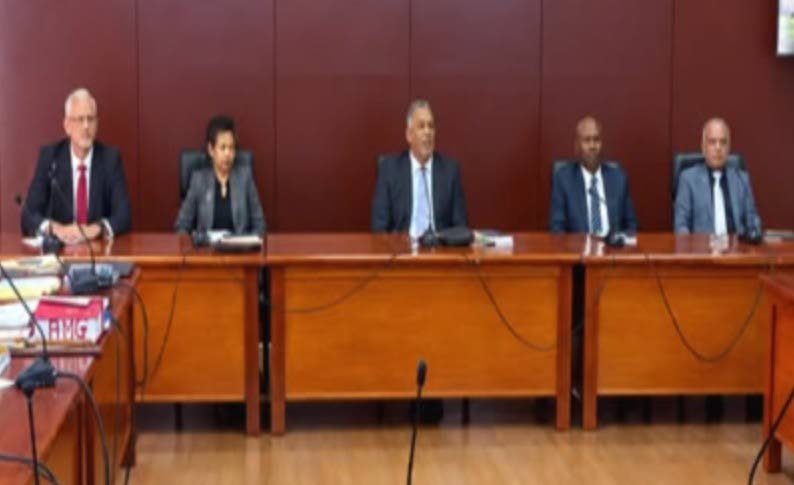 The five-member Commission of Inquiry chaired by Justice Godfrey Phillip Smith of Belize hearing testimony from the public into the fatal July 18, 2026 boating incident in Guyana that resulted in the deaths of 100 people.
-
The five-member Commission of Inquiry chaired by Justice Godfrey Phillip Smith of Belize hearing testimony from the public into the fatal July 18, 2026 boating incident in Guyana that resulted in the deaths of 100 people.
-
 Survivors in the water after MV Burima capsizes. Photo - CMC
GEORGETOWN, Guyana, CMC – The Commission of Inquiry (COI) into the July 18 boating incident in Guyana that left more than 100 people dead heard on Wednesday that the emergency beacon on the ferry, the MV Barima, was not registered.
Director of the Air Navigation Services Department at the Guyana Civil Aviation Authority (GCAA), Rickford Samaroo, also said that he became aware of the incident only at around 11:00 a.m. on July 19, more than two hours after the first alert.
“From our side, it wasn’t registered,” he said when asked by Trinidad and Tobago maritime law expert Nyree Alfonso.
GCAA’s Aeronautical Information Service officer, Tia Valenzuela, said she was on duty at the Cheddi Jagan International Airport’s control tower when she heard a constant beeping at 10:43 p.m. on July 19. She said she then printed a related message.
Valenzuela said that, due to the absence of registration information, she could not contact anyone, such as the owner, in relation to the beacon.
The vessel was on its way from Georgetown to Port Kaituma, a small village within the Barima-Waini administrative region of the country, when the incident occurred.
It was carrying an estimated 179 passengers and crew when it sank. Authorities recovered 72 bodies, rescued 76 people and said 30 others remained unaccounted for.
They are also disputing the number of people who were on board the vessel.
Retired acting Chancellor Carl Singh has since said that he would be representing the Minister of Public Works, Bishop Juan Edghill, at the Commission of Inquiry.
In the aftermath of the tragedy, the vessel’s captain, chief mate and the Transport and Harbours Department’s Goods Superintendent were charged with murder.
The five-member COI, which is chaired by Justice Godfrey Phillip Smith of Belize, has been tasked with establishing the circumstances surrounding the tragedy, including the causes and factors related to the loading of the vessel, the boarding of passengers, conditions on board and the vessel’s capsizing and sinking.
It will also examine the adequacy of search, rescue and recovery operations, the vessel’s seaworthiness and maintenance history, and the competence of its crew.
In addition, the inquiry will determine whether applicable laws and operating procedures were followed and whether negligence, misconduct, dereliction of duty or other failures contributed to the disaster.
Samaroo, who is among 100 witnesses expected to give evidence before the commission, whose initial two-month timeline has been extended to six months, said that the emergency beacon’s lack of registration meant that its identification code could not be matched to registration records containing details about the vessel, its owner and emergency contacts.
Samaroo told the commission that distress alerts began arriving at 10:43 p.m. on July 18, but staff were not required to notify him immediately of signals involving a vessel.
He said he became aware of the incident only after receiving a call from the GCAA’s director general at about 1:00 a.m., more than two hours after the first alert.
He said that the director general informed him that a vessel might be in distress and that approval had been given for two aircraft to investigate.
An emergency beacon transmits a distress signal to help search and rescue authorities locate people in danger. An Emergency Position-Indicating Radio Beacon, or EPIRB, is the type used in maritime emergencies.
It transmits on the 406 MHz frequency through the international Cospas-Sarsat satellite search and rescue system. Depending on its design, it can be activated manually or automatically.
An unregistered beacon can still transmit a distress signal and provide location information, but it does not provide the accompanying registration record that helps authorities identify the vessel and contact people familiar with its movements.
Samaroo told the commission that the beacon aboard the MV Barima was not registered, noting that Guyana receives distress alerts through an arrangement with the United States Mission Control Centre as part of the international satellite system.
The alert messages contain information including the beacon’s identification code, the date and time, geographical coordinates and an indication of the reliability of the location.
Samaroo said that, after receiving the director general’s call, he contacted the control tower to advise that the two aircraft had been authorised to proceed. It was during that contact that he learnt of the distress messages received from the United States.
Distinguishing between the procedures for aviation and maritime alerts, Samaroo said staff were required to inform him immediately of an aircraft distress signal, but there was no equivalent requirement to notify him immediately of one involving a vessel.
According to the briefing he received from staff, the Maritime Administration Department, the GDF Coast Guard and the lighthouse were notified within five minutes of receipt of the alert.
Meanwhile, although the media has been invited to cover and record the daily hearings, media houses will not be allowed to broadcast the hearings live.
The Secretary to the Commission, Javed Shadick, did not offer a reason for the decision.
Follow The Gleaner on X, formerly Twitter, and Instagram @JamaicaGleaner and on Facebook @GleanerJamaica. Send us a message on WhatsApp at 1-876-499-0169 or email us at onlinefeedback@gleanerjm.com or editors@gleanerjm.com.