
Hives under threat
Invasive Cuban tree frog preying on bee colonies as disruption to local ecosystem continues; pet birds also at risk
Published:Sunday | January 5, 2025 | 12:12 AMRochelle Clayton - Staff Reporter


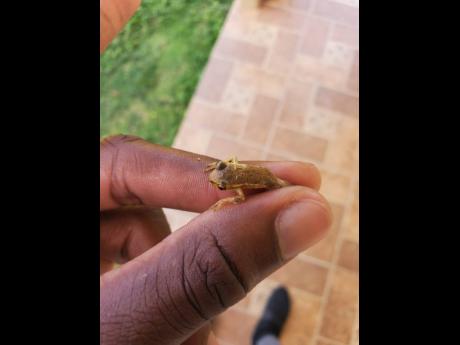


Bee farmers in Jamaica are growing increasingly concerned about the impact of the invasive Cuban tree frog on their hives.
Scientifically known as Osteopilus septentrionalis, the Cuban tree frog is native to Cuba, The Bahamas and the Cayman Islands. The invasive frog is believed to have been brought to Jamaica approximately six years ago.
Bee farmers in several parishes have reported frequent sightings of the frog near their hives, where it preys on weaker colonies, potentially leading to significant losses during critical periods.
Clarendon bee farmer Sheldon Lewin is among those concerned.
“I am seeing them more frequently in the May Pen area, so I am a little bit worried that they are targeting specific hives there and I may lose population at the opportune for them to produce, but I don't even know what to do,” Lewin told The Sunday Gleaner.
“They are always underneath the hives or covers just hiding out in the day, but I don't know how they are affecting the bees because I haven't dissected any frogs to see if they are eating them,” he added.
But with the frog's affinity for jumping and climbing, he acknowledged that bee farmers are in a quandary.
“We can't really do anything because with the regular frogs, we would just make our hives higher. My hives are usually 20 inches off the ground from the usual frogs, but the tree frogs can jump. I have had stacks of boxes at least seven feet off the ground, and they are actually on the top of the cover,” said Lewin.
Another bee farmer, Rhona Whyte, shared a similar experience. She told The Sunday Gleaner that it preys on weak hives by eating the sick bees.
'THEY ARE FRIGHTENING'
“I am afraid of them because they are frightening. When you open the boxes, you will see them on the covers. I believe that they go through the windows because they can make themselves very small and they eat out the bees, and after a while your [colony] will get weaker or you lose it overall. I experienced that with one in St Elizabeth,” she said.
Damion Whyte, a local biologist, told The Sunday Gleaner that the first reported sighting of the frog in Jamaica was in early 2019 at the Longville Park Fish Farm in Clarendon. Since then, the invasive frog has spread across eight parishes.
Whyte, who uses social media to track the frog's movement, acknowledged that it is posing a growing threat to the local bee farming industry.
“My mother is also a bee farmer, who has hives in Clarendon and also St Elizabeth. What she found out is that whenever you have weak hives, the Cuban tree frogs go to the mouth of the hive to sit and wait for the bees to come in. Sometimes they even go inside the boxes,” he explained.
DISTINCT TRAITS
Whyte also noted the Cuban tree frog's distinct traits that set it apart from Jamaica's native amphibians. Unlike local frogs, the Cuban tree frog can climb and leap into high spaces. It is also known for its loud wailing sound, reminiscent of a baby cat.
In addition, the frog's voracious appetite allows it to consume anything that fits in its mouth, further threatening the local ecosystem.
“We got reports from Florida that it is eating the native frogs there. They eat lizards and small snakes, so they are a big threat to the environment. We don't know if they are hybridising with our native frogs,” said Whyte.
“They also produce a secretion and some people are allergic to it. Some people have reported a skin rash. It might even trigger asthma attacks. Also, some of the pets that eat it may vomit, but it (secretion) is not as poisonous as the cane toad that we call bullfrog,” he told The Sunday Gleaner.
To curb the spread of the invasive frog, Whyte suggested that residents take proactive measures similar to those used in mosquito control.
“They need stagnant water, so cover the drums properly so the frogs don't go in there and lay their eggs. If you have drains on your property, clean them so the water runs. If you can't clear some of the drains, just put fish in there – like tiki tiki – to eat the tadpoles. When they breed in the tanks, that also affects the water quality. We want people to kill them,” he said.
Alex Simpson, assistant science officer and lead enforcement officer at the Caribbean-Coastal Area Management (CCAM), confirmed that residents are being urged to eliminate the Cuban tree frog.
“Kill them, but we do not recommend using household chemicals,” he told The Sunday Gleaner.
“With talking to local residents, you know the local myths surrounding frogs, as well as the local ways that they try to kill frogs, such as throwing salt on them. I've heard cases of people using bleach [and] paint thinner, but we encourage persons not to do that,” Simpson said.
He recommended that residents kill the frogs using simple methods like striking them with a blunt object at the back of the head or freezing them.
Simpson also reported that CCAM has been monitoring the frog's spread across the southern part of Jamaica, where they have been infiltrating homes and infrastructure.
“The primary thing is plumbing. So what they will do is, if there's a cracked sewer main or a cracked pipe, during the daytime, they will congregate in those areas and they'll clog up your pipes and your drainage system,” he said.
“If plants are in your yard, like [aloe vera], banana or mango, they tend to hide between the leaves during the day and then come out at night. They also will go into your house. We've had a few calls where we've had to go to a person's house to remove them. If you have [small] pet birds, those are not off the menu for them. They will try to eat the bird if they can get to it,” he said.