Theresa Rodriguez-Moodie | When rights exist but justice is out of reach
Loading article...
-
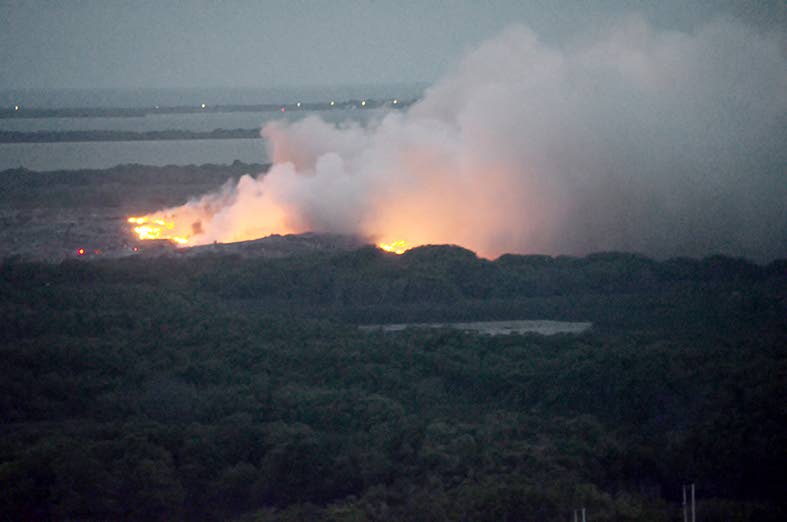 Frequent fires at the Riverton City Landfill in St Andrew often result in life-threatening air pollution.
-
 Theresa Rodriguez-Moodie Con
“WE WAAH JUSTICE!”
It is a phrase we have all seen on placards at various protests across Jamaica. But what does it mean to seek justice?
Consider the experience of a woman who spent years trying to stop illegal burning in her community. In 2023, she reported frequent fires and heavy smoke to the National Environment and Planning Agency (NEPA), the Environmental Health Unit in the Ministry of Health and Wellness, and the Kingston and St Andrew Municipal Corporation. She described smoke entering her home and affecting her ability to breathe. She was advised the matter would be investigated.
When the problem continued, however, she asked the Jamaica Environment Trust (JET) to assist. We wrote to NEPA and the Jamaica Fire Brigade and were similarly advised that the matter would be investigated. JET also contacted the relevant Municipal Corporation. After months of back and forth between government agencies without a clear resolution, she eventually stopped following up, even though the burning continued.
She was seeking justice. As a Jamaican, she has a constitutional right to “enjoy a healthy environment” , including clean air to breathe. This gap between having a right and being able to enjoy it is at the heart of the conversation about access to justice. For many Jamaicans, access to justice is elusive.
WHAT’S ACCESS TO JUSTICE?
Access to justice means being able to receive help, challenge wrongdoing and obtain a meaningful remedy when your rights are violated or when the law is not being followed.
Most people tend to associate justice with courts and lawyers, but access to justice starts long before the courtroom.
If someone reports pollution, they should be able to get a timely response. If an environmental law has been broken, there should be a way to have the matter investigated and resolved. If a government decision appears to be unlawful, people should have a realistic way to challenge it, and, if harm has occurred, there should be a way to seek an appropriate remedy.
This is particularly important for environmental issues because environmental harm can have long-term, far-reaching negative impacts, some of which can be irreversible.
Pollution affects people’s health. Destruction of wetlands increases flooding and damages property. Damage to rivers compromises livelihoods and water security. Poorly planned development threatens communities and ecosystems.
THE ESCAZÚ AGREEMENT
Access to justice is the third pillar of the Escazú Agreement, the first regional environmental treaty specifically focused on ensuring that people can exercise three fundamental rights: access to environmental information, meaningful public participation in environmental decision-making, and access to justice in environmental matters. It also includes protections for people who advocate for nature, also called ‘environmental defenders’.
These rights are connected. People need information to know what is happening. They need opportunities to participate in decisions that may affect them and then, when something goes wrong, they need to be able to challenge decisions, seek remedies and get accountability.
Jamaica signed the Escazú Agreement in 2019 but has not yet ratified it.
WHAT HAPPENS WHEN JUSTICE IS OUT OF REACH?
Through a project supported by the Global Environment Facility Small Grants Programme (GEF SGP), implemented by the United Nations Development Programme (UNDP), JET has been examining what access to justice looks like in practice for people working to protect Jamaica’s environment. What we have found, and through our own experience, is that having rights on paper does not mean that people can realistically enforce them.
For many Jamaicans, the justice system feels out of reach. Legal action is expensive. Lawyers with the expertise and willingness to take on complex environmental cases are not easy to find. Environmental cases often require technical experts and specialist evidence, creating additional costs that communities and small organisations cannot afford. There is uncertainty about who can bring a case, where to go for assistance, what evidence is needed and what steps to take.
JET and other civil society groups have also experienced these barriers.
Some legal actions, such as a judicial review, must generally be brought within a short time frame. Yet, much of the information needed to determine whether a legal challenge can be mounted has to be obtained through an Access to Information request. JET has found that information on particularly controversial matters is difficult to get and often delayed. By the time requests are answered or appeals completed, the window for taking legal action may have passed. The ATI Act also primarily applies to public authorities, meaning that much information held by private companies remains out of reach.
There is also an enforcement gap. Jamaica has environmental laws, regulations, permit conditions and procedures, but there are numerous cases of breaches that are neither properly monitored nor enforced.
When complaints go unanswered, are passed from one agency to another, or are delayed while environmental damage continues, people are left feeling that the law does not work for them.
The 2023 Rio Cobre pollution incident illustrates some of these challenges. Residents of Zephyrton, St Catherine, reported pollution in the river, requesting that NEPA investigate. NEPA initially concluded that there was no evidence of pollutants or impacts on the river. Following a community protest, NEPA returned to collect water-quality samples. JET requested the results under the Access to Information Act, but the request was initially denied and had to be appealed. The results were eventually released and confirmed that a discharge had occurred. The case highlights the need for stronger monitoring of the river and for community reports of environmental harm to be properly investigated and followed up.
For environmental defenders who challenge powerful interests, they may face professional, social or political pressure and risks. Their credibility may be questioned, or they may be accused of being politically motivated. These pressures discourage people from pursuing complaints or taking further action.
Access to justice therefore requires more than having laws and courts. People must be able to use the system to enforce their rights without unreasonable barriers or fear of retaliation.
NOW WHAT?
The Escazú Agreement recognises that access to justice requires procedures that are accessible, timely, transparent and not prohibitively expensive. It also recognises the need for support for people who cannot afford to pursue environmental matters via the courts.
Jamaica should ratify the Escazú Agreement, but ratification alone will not solve the problems we have identified. We also need to take a serious and systematic look at how people actually experience the justice system and address the barriers that prevent them from using it effectively.
Theresa Rodriguez-Moodie is an environmental scientist and chief executive officer of the Jamaica Environment Trust. Send feedback to columns@gleanerjm.com