
Accounting in the 1950s: The mechanical calculator
Published:Sunday | June 1, 2025 | 12:09 AM
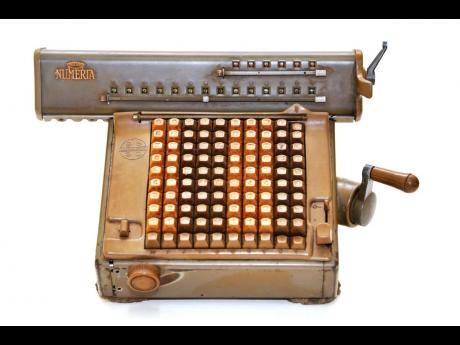
Today, people can easily use the calculator app on their phones to calculate their monthly budgets, students can bring a small digital calculator to exams, or cashiers can quickly tally the totals of goods on their registers. It’s easy for people to overlook the simple convenience that modern calculators and calculating machines have given them.
These advancements stand in contrast to the analogue calculators used in the 1950s. Instead of being powerful and portable, most calculators in the mid-1900s were large, bulky mechanical devices not designed for convenient transportation. Compared to today’s straightforward and user-friendly devices, analogue calculators were cumbersome and required training to understand most functions. Although some 1950s calculators resembled the modern 10-digit devices from a design perspective, they were limited in function and could only add or subtract a limited number of values.
Full-function calculators capable of much more complex computations of higher values had a full-keyboard layout with 100 keys, such as Lagomarsino’s Numeria 7101, which could perform all four primary calculating functions: addition, subtraction, multiplication, and division. Even though most households at the time would have had little need for such a comprehensive calculator, and few could afford one, the 7101 model of Numerica calculators still became one of Lagomarsino’s most successful products. By the 1960s, the Model 7101 had become one of the most popular calculators in Europe and European colonies, including Jamaica. These calculators were especially favoured among financial institutions, such as banks and accounting firms, where they were a piece of standard equipment.
FREQUENT SERVICING
Like most, if not all, mechanical calculators, the Numerica calculator needed frequent servicing to ensure proper function. Without adequate maintenance, keys and gears would begin to seize and stick, resulting in wrong calculations. This inconvenience caused mechanical calculators to lose favour amongst users and led to the eventual collapse of the mechanical calculator industry. As this industry waned in the 1970s, smaller digital calculators began to rise in popularity, signifying the end of a nearly 120-year-old era. By 1987, the Lagomarsino Company had ceased operations as the Numerica line lost popularity.
Established in 1896 by Enrico Lagomarsino in Milan, Italy, the Lagomarsino Company was a family-owned and operated company that became a leading manufacturer and distributor of office supplies and several calculator models. Until the 1930s, most of the calculators supplied by the company were American imports. However, they decided to shift to manufacturing their own line of calculating machines.
In the early 1930s, the Lagomarsino company acquired P.S.I.C. (Primo Stabilimento Italiano Calcolatrici, Pavia), which had recently begun producing a calculator called the Logistea, a model that resembled older American Monroe full-keyboard calculators.
This was aimed at developing a product that could match the Monroe calculators. Around the same time, Lagomarsino acquired licences to manufacture copies of the Swedish Addo-X Adding Listing Machine and later the American Monroe Calculating Machine.
However, the licenses only permitted reproducing the exterior design of the calculators, not the internal calculating mechanisms. The Lagomarsino Company sold these copies under the sales trade names Numeria (American Monroe copy) and Totalia (Swedish Addo-X copy) Calculating Machines.
While mechanical calculators are no longer mass-produced for general use, some are still made in limited quantities, primarily for collectors or enthusiasts. The widespread adoption of electronic calculators and computers has rendered them largely obsolete. TLagamarsino’s Numerica 7101 calculator has found a home in the National Museum’s collection.
Contributed by Romaine Thomas, assistant curator at the National Museum Jamaica, Institute of Jamaica.