Jeanette Calder | The law provided for oversight – government chose otherwise
Loading article...
-
 Jeanette Calder. Photo - Contributed
-
Jeanette Calder. Photo - Contributed
-
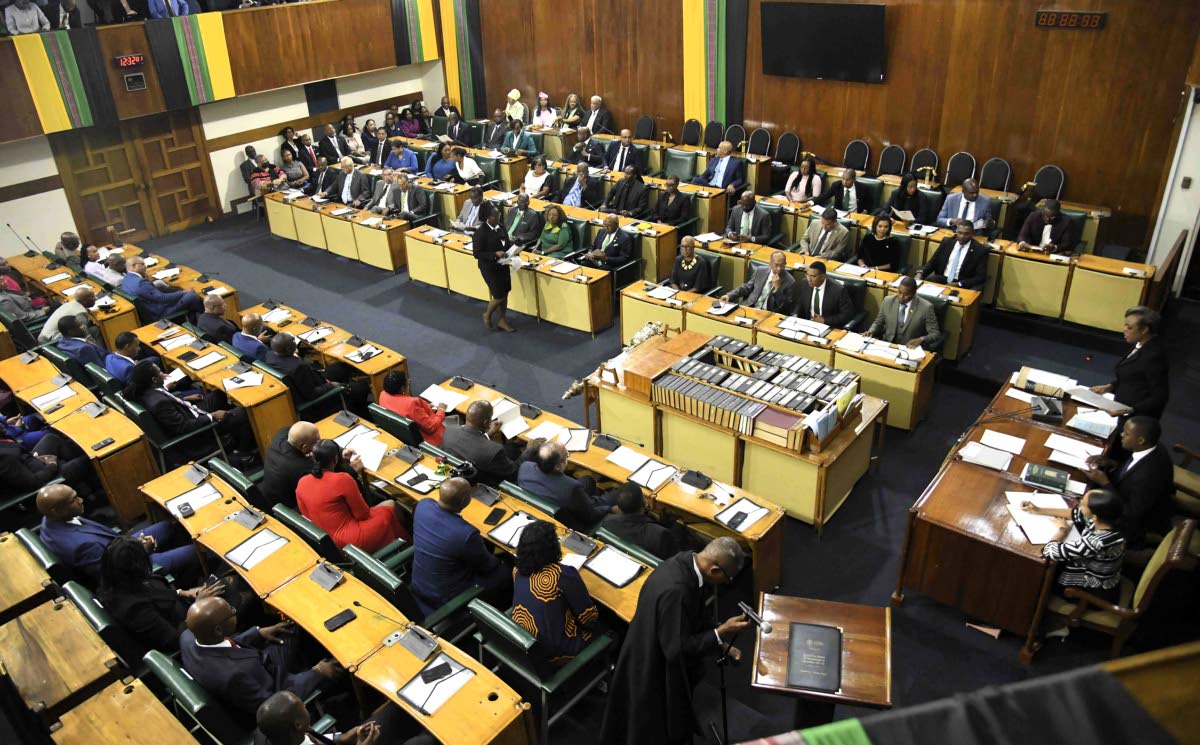 Members of Parliament before at the swearing-in ceremony for members of the upper and lower houses of Parliament held on September 18, 2025 in Gordon House. Photo - File
“ODPEM could not provide a complete distribution trail to confirm that donated consumables [valued at $7.08 billion] reached the intended communities and individuals. As a result, there was no complete trail to show that donated consumables reached those affected by the hurricane.”
Those were gut-wrenching words to read on page 9 of the latest Auditor General’s report. There is no one explanation, but we examined the governance arrangements for disaster management, and what we found was instructive.
On October 25, 2025, at a Special Press Briefing, the prime minister made a commitment. He had said, “There is an existing legislative framework which guides how we respond to crises that we term disasters, and that is the Disaster Risk Management Act, and that is the framework within which we will operate.”
On October 31, 2025, the prime minister established the Relief and Recovery Oversight Committee (RROC), made up of nine cabinet ministers. The name promised oversight, but a deeper look said otherwise. It was co-chaired by MP Desmond McKenzie, the minister responsible for local government and community development, and included MP Pearnel Charles Jr, whose Ministry of Labour and Social Security leads humanitarian assistance. These were the very ministers primarily responsible for carrying out the relief effort. By what definition of oversight could ministers alone oversee this effort?
However, Parliament had already provided a very different arrangement in the Disaster Risk Management Act, 2015 (DRMA). It speaks to a standing statutory council to “facilitate effective national coordination of, preparedness for, response to and recovery from any disaster or emergency situation and collaboration of stakeholders”. Its members are pre-determined by law and include the leader of the Opposition, the general secretaries of both parties, several civil society associations and members of the public sector. It requires the council to report to Cabinet every year. What a stark contrast with a committee of Cabinet ministers!
This decision is all the more troubling because Prime Minister Holness acknowledged in Parliament on November 4, 2025 that he had “heard the calls from various quarters for the establishment of a national oversight structure to guide and monitor the distribution of relief and recovery resources”.
WHAT CALLS WERE THOSE?
In the days after Hurricane Melissa struck, the call for a broad, multi-stakeholder oversight body came from every quarter. On October 29, Opposition Leader Mark Golding wrote to the prime minister urging a broad-based national task force of the Government, the Opposition, the private sector, non-governmental organisations and the church community to oversee the handling and distribution of relief.
On November 2, the presidents of three private-sector bodies wrote jointly to the prime minister recommending the formation of an Oversight and Recovery Committee comprising the Government, the Opposition, the private sector and civil society. John Azar, CEO of King Alarm Systems, spoke for thousands when he penned the article in The Gleaner, ‘Transparent and Inclusive Approach Needed to Aid Distribution’, encouraging the Government “to remove any perception of uncertainty” by putting in place a “bipartisan oversight body to supervise the management and distribution of all donations”.
The Montego Bay-based Community Organization for Management and Sustainable Development called for a “broad-based national coalition to oversee the rebuilding efforts” and the Jamaica Council of Churches offered to join “collaborative and coordinated initiatives”. Civil society actors and countless citizens on social media echoed similar sentiments, while not appreciating that the very legislative framework within which the prime minister said the Government would be operating had already provided for their inclusion.
GOVERNANCE CONUNDRUM
Prime ministers have a different prism through which they analyse problems and arrive at solutions. However, taking on responsibility for ODPEM and failing to make use of the council provided by the DRMA created serious governance concerns.
The act names the prime minister as chairman of the council and the minister responsible for disaster preparedness as deputy chairman. Since the prime minister took ODPEM into his own office, he now holds both positions. A deputy chairman is there to provide continuity and a second senior voice. When the prime minister holds both posts, that necessary ‘second voice’ disappears.
A quorum of the council is the chairman or deputy chairman plus 10 other members. Since both are the same person, no one else can chair it. The council’s ability to function is therefore entirely dependent on the availability of the prime minister. Perhaps that explains why a council created to “facilitate effective national coordination of, preparedness for, response to and recovery from any disaster” had not met for seven months after Melissa. Additionally, under Paragraph 7(b) of the Second Schedule, the council must review “the state of disaster management in Jamaica”. ODPEM is at the heart of that effort, so the review would be led by the very minister to whom it answers.
The other significant concern relates to the number of public entities for which Dr Holness has oversight responsibility. They include the Ministry of Economic Growth and Job Creation, the Office of the Prime Minister, four executive agencies ,and 36 public bodies, with ODPEM and NaRRA being the most recent additions. To what extent did the prime minister, by spreading himself this thin, leave ODPEM without the guidance and ministerial support it needed?
It is not too late. Recovery from Melissa will take years, and the next hurricane season is six months away. We urge the prime minister to:
• listen to the many Jamaicans who saw the wisdom of broad-based oversight and turn to the body the law already provides, keeping it meeting regularly while recovery continues;
• assign responsibility for disaster preparedness to another minister;
• use the council’s power under Paragraph 4 of the Second Schedule to set up a relief and recovery committee, with civil society at the table, to monitor how the remaining donations are distributed; and
• make public the council’s annual report to Cabinet.
The framework is there. The voices are there. What remains is the will to use them.
Jeanette A. Calder is the executive director of the Jamaica Accountability Meter Portal. Send feedback to jeanettec@jampja.org.