Kristen Gyles | While Hurricane Melissa victims wait
Loading article...
-
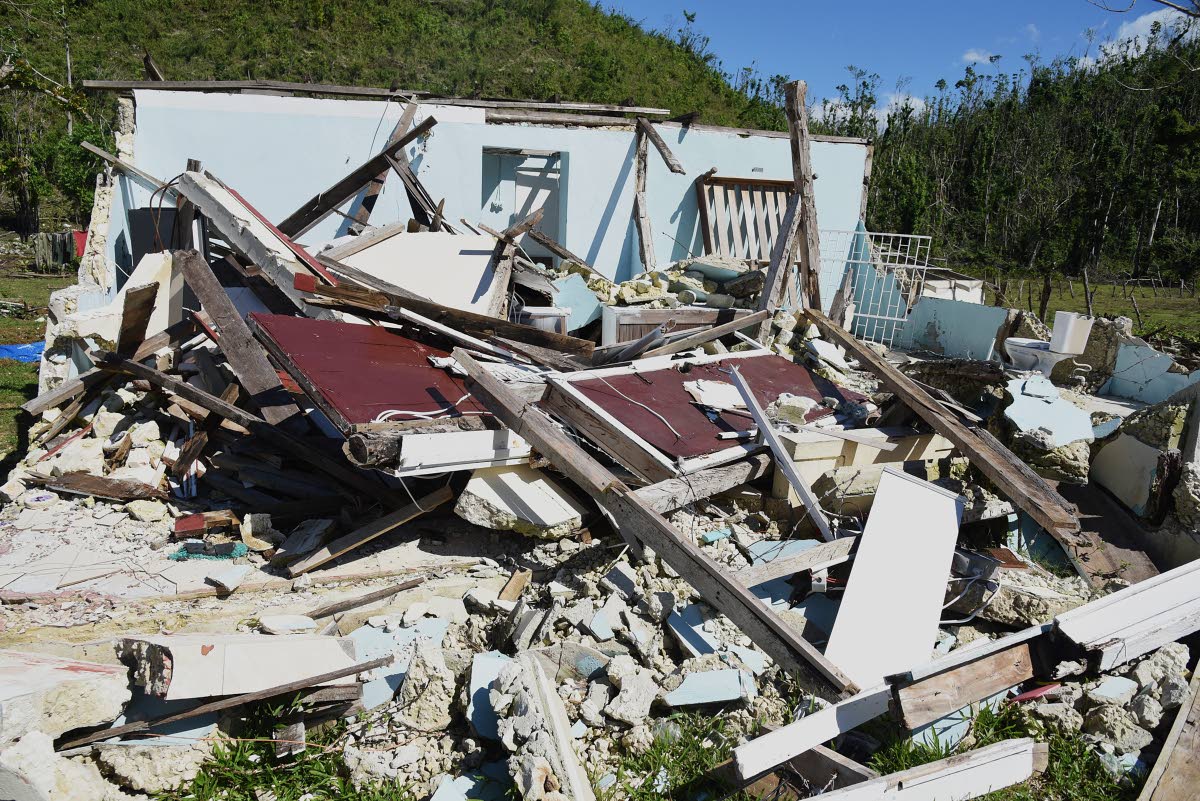 Half of this home in Bog, Westmoreland crumbled during the passage of Hurricane Melissa last October. Photo - File
-
Half of this home in Bog, Westmoreland crumbled during the passage of Hurricane Melissa last October. Photo - File
-
 Kristen Gyles. Photo - File
Imagine there’s a large 10-storey building down the road that has caught fire. The building has people in it. The building has very expensive equipment in it. The building has furniture in it. The building has detailed records and other important documents in it. All may cease to exist in a short while because the building is burning.
Proactive onlookers call the fire department and a team of firefighters arrive promptly on the scene, bringing with them a sense of hope that all will not be lost.
But minutes pass and you notice not a drop of water has touched the building. The fire is raging, but no water hoses have been connected, and no fire-extinguishing devices have been deployed. Instead, the firefighters have neatly set out chairs, in rows and columns, and have convened a meeting to strategise how to prevent the next fire. Some really bright ideas are being expressed and the discussion is quite robust. They even go on to discuss plans for putting up a new building and the type of building materials that can be used. Furthermore, they discuss how the pothole on the adjacent street can be patched to allow for a smoother flow of traffic to another, similar building nearby. They really leave no stone unturned.
Meanwhile, the onlookers are running with small buckets and other containers of water, hoping to put out the raging fire. Of course, that only helps a little.
Before the firefighters finish their very important meeting, the fire consumes all. But, at least the new building will be grand, and even better than the one that preceded it. Right?
This is how the development of the National Reconstruction and Resilience Authority (NaRRA) feels from the perspective of many ‘onlookers’. While long-term plans are still being laid, Hurricane Melissa victims continue to languish in want of help.
First, the NaRRA was branded as an entity whose purpose was to coordinate and accelerate recovery and reconstruction following the passage of Hurricane Melissa. However, rather than simply replacing the buildings that had been lost to the hurricane, the idea seemed to be that reconstruction efforts should produce infrastructure of a much higher standard and quality than previously existed, so that public facilities especially would be more ‘resilient’ and less susceptible to the effects of climate change.
All of that sounds great but, if we knew that reaching for the stars would mean that, after almost one full year, hardly any new buildings would have been erected, we would have settled for plain-vanilla replacement buildings. At least then, residents of communities badly damaged by the hurricane would perhaps now have fully operational schools, police stations, hospitals and roads like they did before the hurricane.
The controversy surrounding the establishment of the NaRRA arises largely because not only have all the legal and administrative processes associated with the commencement of the actual reconstruction taken as long as they have, but because, after so much time has passed, it almost feels as though the initial objective has now been lost.
Up until last week, it was reported that the Black River Hospital and Cornwall Regional Hospital, for example, were still undergoing reconstruction and were therefore not fully operational because of damage caused by Hurricane Melissa. Why then, at this stage when those most badly affected by Hurricane Melissa have not yet been made whole, would the NaRRA be coordinating projects all over the island?
We are now hearing about an upgrade project relating to the Palisadoes strip, expansion of the Hermitage Dam and all other kinds of extensive projects. It’s almost as though an entity that we thought was being put in place to focus on the restoration of communities ravaged by the hurricane is actually a machine for churning out all sorts of new capital projects.
These projects are all important and should be embarked upon, but one wonders whether they should be executed using funds donated specifically to help victims of Hurricane Melissa get back on their feet. On supportjamaica.gov.jm, the official government website set up to receive contributions from donors, the ‘donate now’ button bears the caption: “Your donation provides food, shelter, medical aid and more to families affected by Hurricane Melissa. Every contribution helps rebuild lives and restore hope.”
Individuals who donated out of the kindness of their hearts did so because they saw the images of flattened homes and read the news articles of hurricane victims who had no clue where their next meal would come from. They donated because they wanted to help hurricane victims, not necessarily because they wanted to see the Palisadoes strip upgraded. Charitable donations from other governments and from international agencies also appear to have been given in good faith that funds would be channelled towards the assistance of those worst affected by the hurricane.
Also, it really is ironic. Jamaica clearly has an efficiency problem, and it is the very agency put in place to reduce the administrative delays associated with reconstruction that is demonstrating the bureaucracy supposedly being shunned. Since Hurricane Melissa, a bill was drafted to establish the NaRRA. The bill was debated in Parliament, office space was eventually located, a CEO was eventually sourced for the entity, and all of that took one year.
We can only surmise how long it would have taken us to get to the point of actual reconstruction had the already existing ODPEM undertaken to allocate the post-Melissa recovery funds.
Some governments have developed 20/20 foresight. They strategise impeccably. But an unexecuted strategy is worth probably just as much as a non-existent one. That is, until it is actually executed. What is critical is bridging the gap between vision and action.
Kristen Gyles is a free-thinking public affairs opinionator. Send feedback to kristengyles@gmail.com and columns@gleanerjm.com