Editorial | Partnership for recovery
Loading article...
-
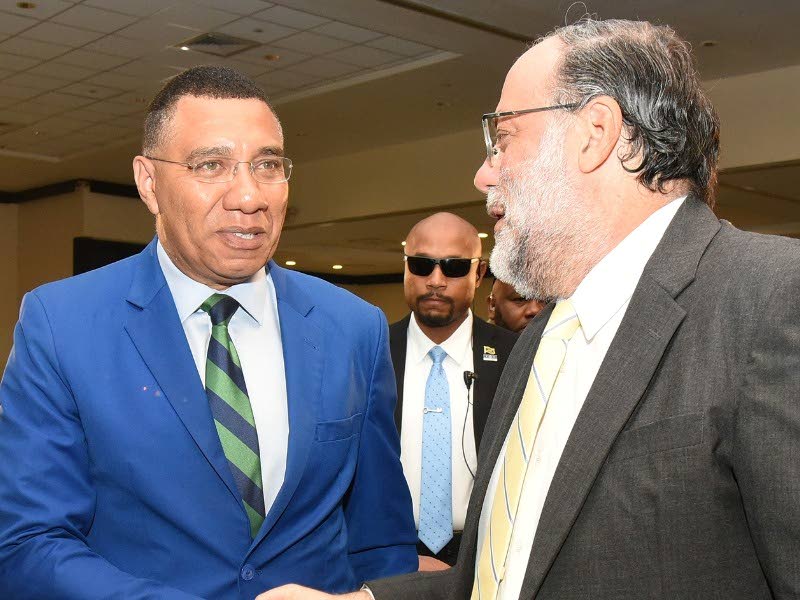 Prime Minister Dr Andrew Holness (left) and Opposition Leader Mark Golding.
-
 File photo
-
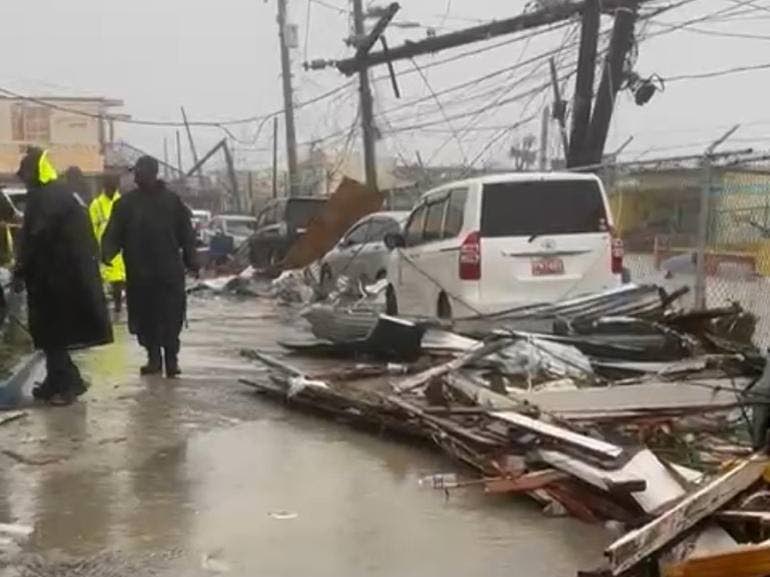 Police personnel at the Black River Police Station in St Elizabeth assessing the damage to the station during the passage of Hurricane Melissa.
-
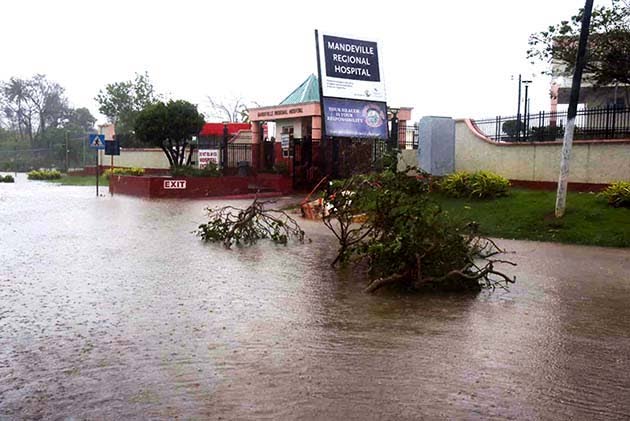 Floodwaters cover a section of Caledonia Avenue in Mandeville, blocking access to the entrance of the Mandeville Regional Hospital after Hurricane Melissa on Tuesday.
The obvious priority for the Government at this time must be to mitigate the immediate impact of the devastation of most of western Jamaica by Melissa – among the most powerful hurricanes ever to hit the island.
But the Government has, at the same time, to concentrate on the lessons learnt from this disaster, and the policies to be pursued in the aftermath, given the storm’s potentially severe drag on the island’s economy.
At least four deaths are so far associated with the weather event. More are likely to emerge. But the human cost of this tragedy is much deeper and wider and will linger for a long time.
In the parishes of St Elizabeth, St James, Hanover and Westmoreland, especially, hundreds of people are displaced, their homes badly compromised or destroyed by the hurricane’s powerful winds. Some buildings are submerged in deep waters left by Melissa’s hammering rains. The scenes in some communities conjure images of the St Elizabeth flood rains of 46 years ago, where, in the town of New Market, only the tops of utility poles and the roofs of those houses on higher ground were visible.
In addition to the losses sustained by individuals and families, public infrastructure – roads, drains, bridges, schools, hospitals –have suffered significant damage. Recovery, in the circumstances, will cost tens of billions of dollars, even as government revenues decline because of a slowdown in economic activity.
Indeed, agriculture, as well as the critical tourism industry, both of which were poised for significant growth this year, will be hit especially hard. With respect to the former, in several of the major farming areas, including south St Elizabeth, thousands of tonnes of produce have been lost in fields and it will be months before farmers can stabilise their situations.
The damage to agriculture will fuel food inflation, spur imports and place pressure on the country’s reserves. At the same time, not only will holiday travellers, for the time being, be skittish about Jamaica, but some hotels will also have to undergo refurbishing before being ready to accommodate visitors. Fortunately, Jamaica’s tourism has in recent decades shown itself to be resilient, which The Gleaner hopes will be replicated in the post-Melissa environment.
GREATER FISCAL SPACE
The broader recovery will be long, difficult and expensive, requiring efficient management, effective partnerships and thoughtful leadership. In several respects, though, Jamaica is in a better position to respond to this disaster than recent ones.
The country’s lower debt-to-GDP ratio, underpinned by the macroeconomic stability of the past dozen years, provides the Government with greater fiscal space within which to deal with some of the unplanned spending the administration will have to undertake.
Additionally, the hurricane was undoubtedly of the magnitude and intensity to trigger the US$185-million catastrophe bond which Jamaica launched nearly four years ago, as well as a call on the parametric insurance arrangement of the Caribbean Catastrophe Risk Insurance Facility.
But even with the contingency funds that have been put aside in budgets over years to respond to catastrophes of this type, these facilities will still be well short of the requirements for recovery. One positive fact, however, is that the Government, after recent adjustments to how the economy is measured, is on target to, by the end of the fiscal year, achieve the legislated goal of debt-to-GDP ratio of 60 per cent. This will be two years ahead of schedule.
In the circumstances, the administration, as is allowed by the law, is in a position to go to Parliament to adjust the timetable for the target, thus providing it room to take on debt to help finance its post-hurricane responses. Further, given the scope of damage to private homes, the Government should creatively work with the National Housing Trust, and perhaps private financial institutions, insofar as that is possible in the context of an independent central bank, to provide borrowers with a short-term insulation against mortgage default, and to help with rehabilitation.
REALITY OF GLOBAL WARMING
Melissa was also a stark reminder of the reality of global warming, the fact that the heating earth is the result of human action, and the dangers posed by global warming to small island states like Jamaica. In that regard, the administration should increase the force with which it articulates the depth of the crisis faced by vulnerable states, and insist that developed countries not only deliver on past pledges, but provide financial support to the extent required by developing countries to build resilience against the changing climate.
Another message from this hurricane is of the need to broaden the base of the Jamaican economy, to build its resilience to events such as Melissa. It is also a statement of the need for a pivot beyond macroeconomic stability with meagre growth, to more robust movement in the economy.
In the immediate term, however, the focus is on recovery. This demands a transparent government that takes citizens fully into its confidence, and is willing to cooperate sincerely with the political Opposition. This has to be about a real partnership.