Exhibition celebrates six decades of George Rodney’s art
Loading article...
-
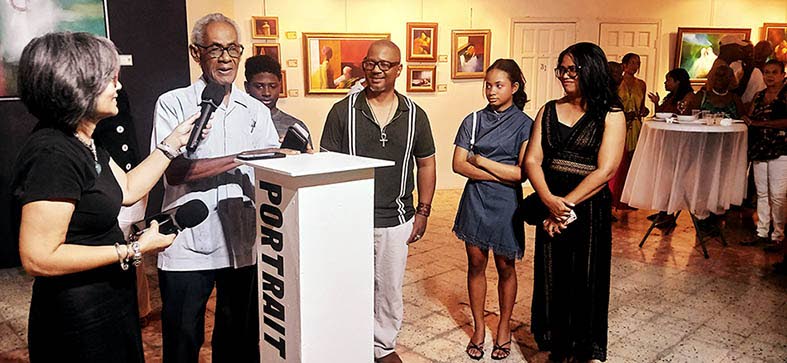 From left: Rosemary Thwaites of Olympia Gallery; Compton Rodney, brother of the late artist George Rodney; his grandson, Alexander Rodney; son, Wayne George; granddaughter, Alysson Rodney; and daughter-in-law, Trecia Rodney, at the opening of The Rich Visual Legacy of George Rodney retrospective exhibition at Olympia Gallery, 202 Old Hope Road, Papine, St Andrew, on November 19. Photo - Photos by Paul H. Williams
-
From left: Rosemary Thwaites of Olympia Gallery; Compton Rodney, brother of the late artist George Rodney; his grandson, Alexander Rodney; son, Wayne George; granddaughter, Alysson Rodney; and daughter-in-law, Trecia Rodney, at the opening of The Rich Visual Legacy of George Rodney retrospective exhibition at Olympia Gallery, 202 Old Hope Road, Papine, St Andrew, on November 19. Photo - Photos by Paul H. Williams
-
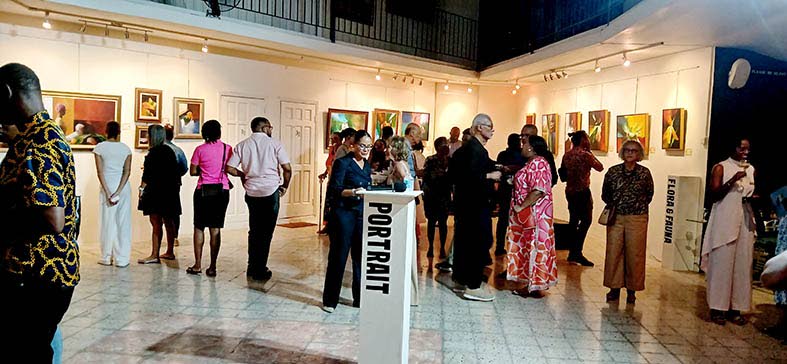 Guests fill Olympia Gallery during the opening of ‘The Rich Visual Legacy of George Rodney’ retrospective exhibition.
The opening of The Rich Visual Legacy of George Rodney at Olympia Gallery on November 19 carried special significance. The prolific Jamaican artist had died on October 8 at age 90, less than two months before the retrospective exhibition celebrating more than six decades of his work was unveiled.
The exhibition, which runs until December 14, was attended by Rodney’s brother, Compton; his son, Wayne George; daughter-in-law, Trecia; granddaughter, Alysson; and grandson, Alexander.
“Spanning Rodney’s 60-year career, the exhibition, ‘The Rich Visual Legacy of George Rodney’, brings together oil and acrylic paintings alongside charcoal and pastel drawings, including rarely seen works from public and private collections,” Olympia Gallery noted.
In exhibition notes, Compton Rodney reflected on his brother’s work and its enduring presence in Jamaica’s public spaces.
“The paintings here tonight bring back very pleasant memories of George’s works. I used to go to the BOJ [Bank of Jamaica] for meetings with Robin Sykes, and it was a joy to see the beautiful paintings in the corridors. Some of these were done by George, and I was always happy to see his works. I know that Governor Arthur Brown liked his work and gave him a lot of encouragement. In recent times, I recall seeing his paintings whenever Governor Byles was on television. I would tell George, and he was happy to hear of this.”
Born Lloyd George Rodney in St Catherine on August 3, 1936, he was the son of a Guyanese chemist who worked as a chief sugar boiler in Jamaica’s sugar industry and a postmistress. He grew up with seven siblings, three of whom were from a different mother. From an early age, art absorbed him.
Compton Rodney, who briefly dabbled in art himself, recalled that his older brother was constantly drawing, prompting their mother to complain that he was wasting his time.
Rodney attended primary school on North Street in Kingston and, at around age 10, joined the Junior Centre at the Institute of Jamaica.
“I don’t remember thinking, ‘I’m going to become an artist.’ I didn’t plan to be an artist. It was simply there from childhood,” he said in a recent interview. “I wanted to become a builder or an architect and, in a way, I still have that desire. When I left school, I worked at the Lands Department as a grade-two draftsman, and then I went to work with an English architectural firm.”
He later attended Kingston Technical High School, where he studied building construction. Although focused on technical subjects, he continued producing artwork, often decorating classroom blackboards at Christmas.
In 1957, while still employed, he enrolled in evening classes at the Jamaica School of Art where he studied for four years.
“I did not intend to be a painter; I just loved art. I began in what was then called commercial art. We didn’t call it graphics in the way we might today. Painters didn’t earn a living in those days; most worked as commercial artists in the advertising agencies. I started in the drawing classes. It wasn’t easy at first, as we had to draw a model from life, which I had never experienced,” he said.
Encouraged by a sister living in New York, Rodney moved there in 1962 to study at The Art Students League. During his time at the institution, he won a competition and secured a one-year scholarship.
A year later, he returned to Jamaica and joined the Jamaica Broadcasting Corporation (JBC) Television as a graphic artist, working behind the scenes in production.
When The Hills Art Gallery opened on Harbour Street in 1953, it became Jamaica’s first major commercial gallery. Although it initially promoted self-taught artists, Rodney and several other contemporary artists would later exhibit there.
After nine years at JBC, Rodney resigned to pursue painting full-time. He also taught at the School of Art, working with first-year students in drawing and second-year students in painting. Although he enjoyed teaching and mentoring young artists, he left in 1990 to devote himself entirely to his own work.
Recalling those early years, Compton Rodney wrote:
“I remember the days in the 1950s when he and I would go to classes at the Junior Centre of the Institute of Jamaica ... He was good ... I also remember decorating the blackboard at Kingston Technical ... His mother (my mother too) was not a fan of what he was doing, but our Aunt Ivy told her one day to leave him alone, as one day that may be how he would earn his living. And, so it was ... I remember the different types of his paintings. First, normal, then cubism, then came in lines, and beautiful colours.”
Rodney built a substantial body of work and completed numerous commissions for private and corporate collections. He was regarded in some quarters as Jamaica’s most commissioned artist.
His achievements earned him numerous awards, including medals at national festivals and exhibitions, the Silver Musgrave Medal in 1975, the Centenary Medal in 1981 and the Prime Minister’s Medal of Appreciation in 1983.
Addressing the opening, Olympia Gallery’s Rosemary Thwaites highlighted the collective effort behind the retrospective.
“This exhibition also took real teamwork. Thanks to the friends of George, the wider team, and my own team for the hard work, long hours, and behind-the-scenes problem-solving that most people never see. Events like this run on effort that doesn’t always get a spotlight, but it’s the effort that makes everything work.
“To everyone who supported the publication (a limited-edition collectible catalogue), contributed to the exhibition, donated proceeds, offered space, promoted the work, or simply showed up, thank you. This was built with care, and it was built together. Most importantly, every step of it was guided by respect for the Rodney family estate and a shared belief that this legacy is worth celebrating and supporting.”
editorial@gleanerjm.com