Earth Today | A call for more climate-friendly cooling strategies
Loading article...
-
 Passive cooling, which reduces a building’s need for air conditioning by improving its design, materials and surroundings, is considered an effective way to help meet the growing demand for cooling as climate change brings more extreme heat. Photo - AI generated image
-
Passive cooling, which reduces a building’s need for air conditioning by improving its design, materials and surroundings, is considered an effective way to help meet the growing demand for cooling as climate change brings more extreme heat. Photo - AI generated image
-
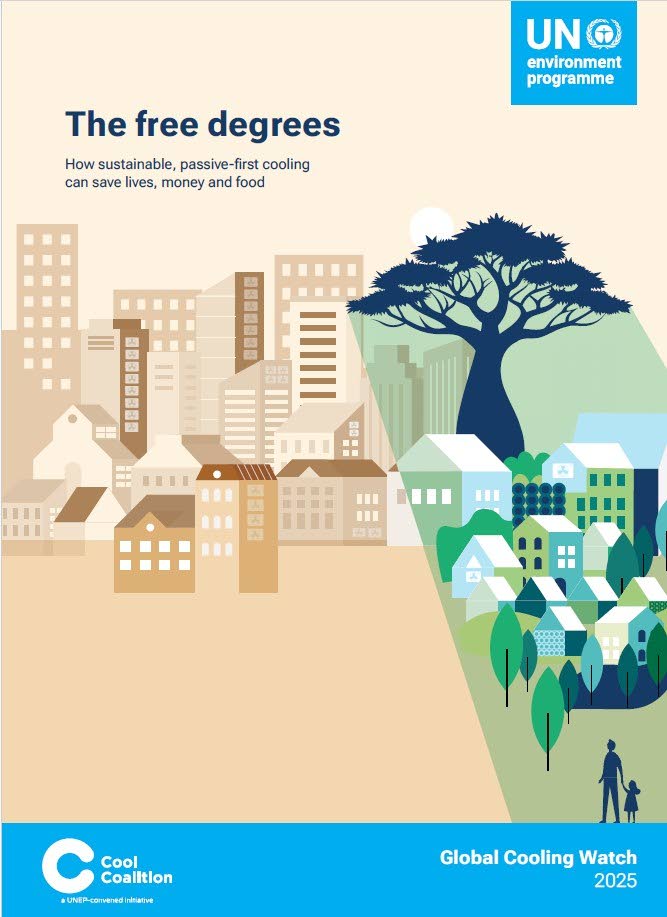 Photo - Contributed
AS CLIMATE change causes temperatures to soar, there is a growing demand for cooling that can come at a significant environmental cost, particularly when generated from fossil fuels.
A recent report from the United Nations Environment Programme (UNEP) reveals that “the surging demand of cooling”, in fact, “risks locking in steep increases in energy use and greenhouse gas (GHG) emissions”, which fuel the changing climate.
“Inefficient air conditioning is already straining electricity grids, driving power outages and forcing costly investments in new power infrastructure. Cooling’s climate challenge is two-sided: to expand affordable, sustainable cooling approaches for adaptation, while cutting the energy and carbon footprint of cooling for mitigation,” noted the Global Cooling Watch report, titled The free degrees.
The report revealed that GHG emissions from refrigeration and air-conditioning equipment came to some 4.1 billion tons of carbon dioxide equivalent (CO2e) globally, “of which roughly one-third was from refrigerant leakage and two-thirds from energy use for cooling”.
“This report finds that the global stock of cooling equipment could more than triple by 2050 – driven mainly by population growth and rising incomes, but also by more frequent extreme heat events and policies to help the poorest households obtain access to some cooling. This would push cooling emissions to 7.2 billion tons of CO2e under a Business-as-Usual Cooling Pathway, despite ongoing energy efficiency and refrigerant phase-down policies,” the 2025 publication noted.
Against this background, the report has championed the move to what it called “a sustainable cooling pathway” – one that can increase access to cooling while yielding trillions in economic savings and potentially reducing GHG emissions from cooling to close to zero in 2050.
“This pathway consists of passive cooling strategies; low-energy and hybrid cooling that combines fans and air conditioners; rapid adoption of high-efficiency equipment; and accelerate phase-down of hydrofluorocarbon refrigerants,” it explained.
“Modelling shows that the 2050 cooling equipment stock could be cut by around 40 per cent and cooling-related emissions reduced to 2.6 billion tons of CO2e, or 64 per cent below business as usual (BAU). When combined with rapid decarbonisation of the global power sector, residual cooling emissions could fall to just 0.2 billion tons of CO2e, or 97 per cent below BAU levels,” the UNEP report added.
However, to get there will require, among other things, policy momentum and attention to implementation gaps. For example, according to the report, “only 54 countries have policies across all three measures consistent with the Sustainable Cooling Pathway: passive cooling in building energy codes, minimum energy performance standards, and rapid refrigerant transition. A further 78 countries cover two of these pillars, 40 cover only one, and 20 have yet to begin”.
“By embedding passive cooling into building design, energy codes permanently reduce the cooling loads of buildings, enabling smaller and more efficient cooling systems, lowering energy use and cutting GHG emissions. However, critical implementation gaps remain in building energy codes worldwide, particularly in developing regions where regulatory frameworks lag urgent cooling needs,” the publication added.
pwr.gleaner@gmail.com