Earth Today | From grassroots to green slopes
Loading article...
-
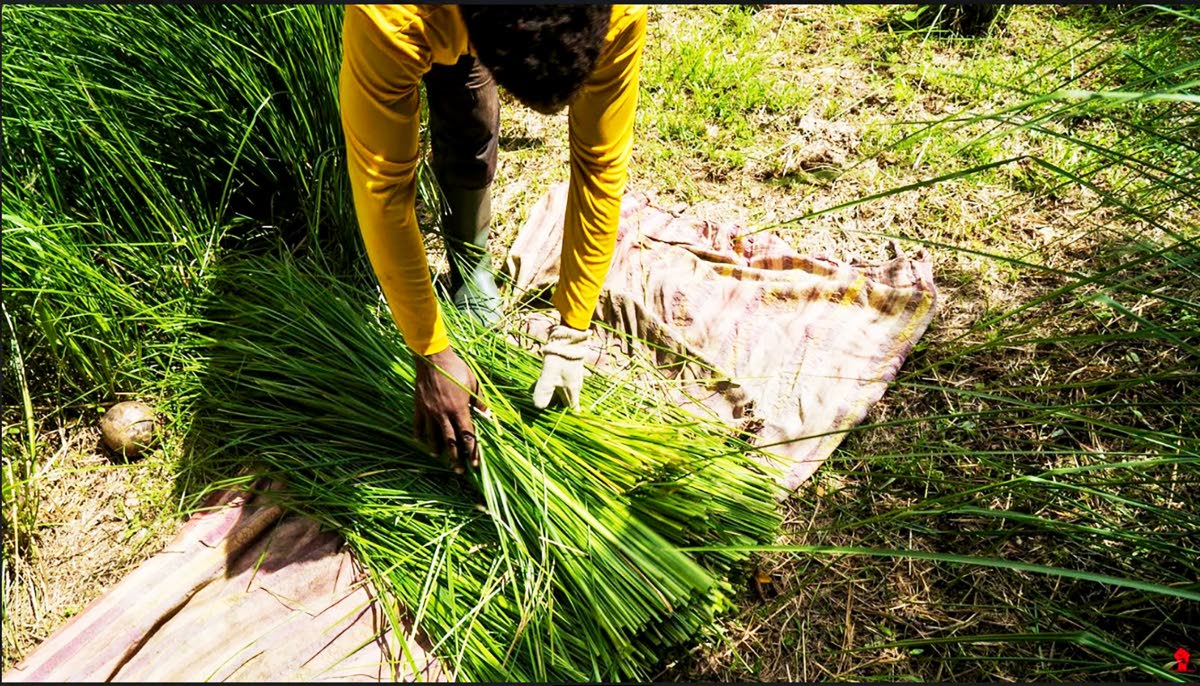 A Caribbean national collects vetiver grass.
-
 A craft vendor in St. Vincent and Grenadines poses with products made from vetiver grass.
CARIBBEAN HILLSIDES have a problem that concrete cannot always fix, and budgets rarely cover – soil erosion.
Soil erosion, worsened by increasingly intense storms and degraded land cover, strips farms bare, silts up rivers, and pushes sediment onto the reefs below. However, in Dominica’s farming communities, one response to this challenge has quite literally taken root, in the form of a grass that has been stabilising slopes and restoring land across more than 100 countries.
Vetiver (Chrysopogon zizanioides), known locally and across the Caribbean as Khus Khus, is a perennial grass originating from India with roots that penetrate three to four metres into the earth, forming a dense underground network that anchors soil against erosion and holds slopes stable under intense rainfall.
Research published in the Journal of Chemical Health Risks found that vetiver can stabilise steep slopes up to 75 per cent incline and reduce erosion by more than 90 per cent compared to bare slopes. The World Bank endorsed its use for soil and water conservation in the 1980s, and it has since been deployed in more than 100 countries. Post-hurricane, Puerto Rico recorded an 85 per cent reduction in sediment reaching waterways on treated slopes.
In the Caribbean, the plant is proving equally valuable. Through the Caribbean Biodiversity Fund, vetiver has been introduced across communities in Antigua and Barbuda, Dominica, Saint Lucia, and Trinidad and Tobago under a project implemented by the Inter-American Institute for Cooperation on Agriculture. The project, branded Vetiver4Lavie, builds on vetiver’s green engineering properties to stabilise farmland, retain groundwater, and reduce the sediment runoff that smothers coral reefs and seagrass beds downstream.
In Dominica, a historic first export of vetiver grass slips to Antigua and Barbuda allowed the plant to take root in a country with no significant local source, opening new ground for regional collaboration. In Saint Vincent and the Grenadines, funding through the CBF and the St Vincent and the Grenadines Conservation Fund has created means for livelihoods for communities through Hand2Earth Inc as vetiver was used to stabilise degraded farmland and improve soil fertility raising crop yields. In Saint Lucia, community resistance to vetiver planting eventually gave way to nationwide adoption by the national water company, illustrating how locally led adaptation can scale to institutional change.
The plant’s value extends beyond its roots. Vetiver leaves are used to produce handicrafts, generating income for women and youth in vulnerable communities in Dominica and beyond. Its above-ground biomass slows water velocity on slopes, allowing rainfall to infiltrate rather than rush off, which in turn recharges groundwater and protects downstream ecosystems. For small island communities already navigating intensifying storms and shifting rainfall patterns, vetiver is doing quietly, and at very low cost, what expensive infrastructure often cannot.
The soil that holds a farm together, keeps a slope from failing, and keeps sediment out of the sea begins with decisions made at the community level. Vetiver shows that when communities are equipped with the right tools and knowledge, a single plant species can protect land, sustain livelihoods, and build resilience from the ground up.
Contributed by Renée Smith, communications officer, Caribbean Biodiversity Fund