Fela Kuti, Chaka Khan, Cher among Grammy Lifetime Achievement awardees
Loading article...
-
 Nigerian musician and composer Fela Anikulapo Kuti performs on September 13, 1986 at the ‘Party of Humankind’ of the French Communist Party at La Courneuve in Paris, France.
-
 Yeni Kuti, daughter of the late Fela Kuti, arrives at the Recording Academy’s Special Merit Awards on Saturday, at the Wilshire Ebell Theatre in Los Angeles. She accepted the award on behalf of her father.
-
 Chaka Khan arrives at the Recording Academy’s Special Merit Awards on Saturday at the Wilshire Ebell Theatre in Los Angeles.
-
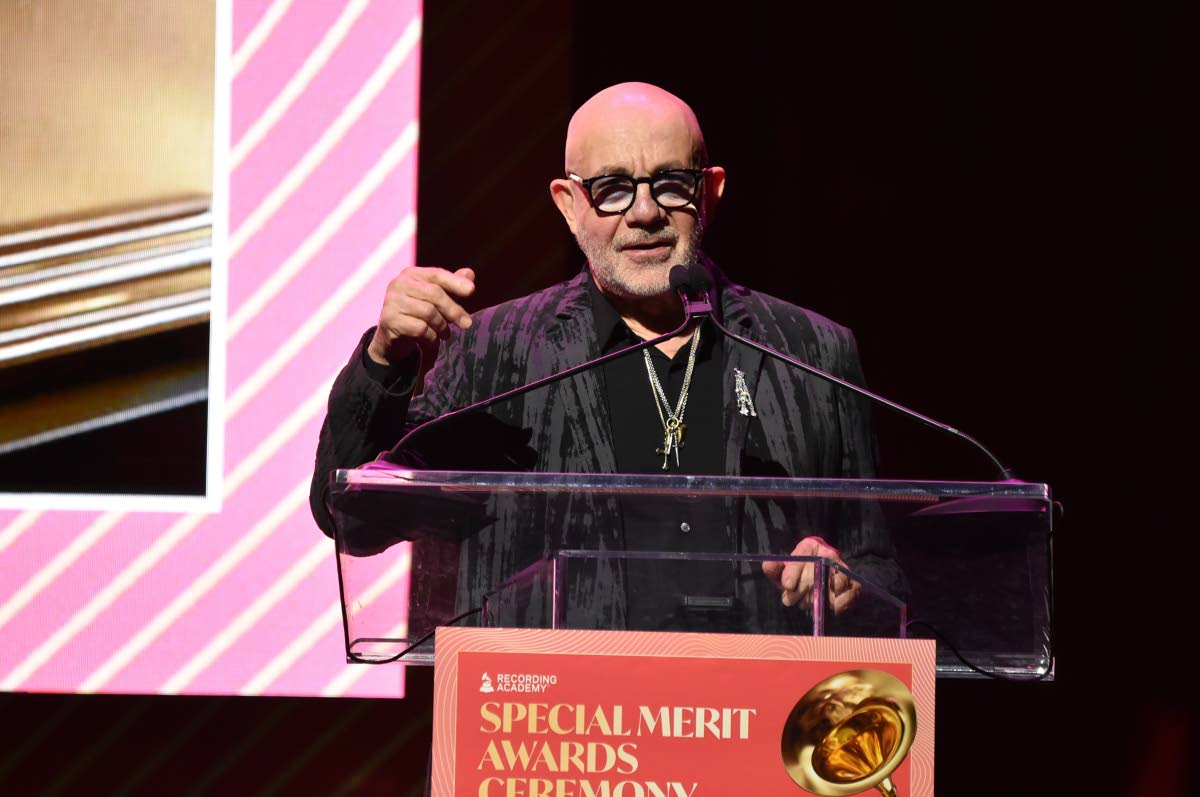 Bernie Taupin accepts the trustees award during the Recording Academy's Special Merit Awards on Saturday.
LOS ANGELES (AP):
Chaka Khan, Cher, Carlos Santana, Paul Simon, Fela Kuti and Whitney Houston received the Lifetime Achievement Award from the Recording Academy at the Grammys Special Merit Awards on Saturday night.
“Music has been my prayer, my healing, my joy, my truth,” Khan said as she accepted the award. “Through it, I saved my life.”
She was the only Lifetime Achievement recipient who appeared at the ceremony at the small Wilshire Ebell Theatre in Los Angeles on the eve of Sunday’s main Grammys ceremony.
She was preceded by a short documentary on her career that highlighted her hits as a member of the funk band Rufus and as a solo artiste, including 1974’s Stevie Wonder-written Tell Me Something Good, Ain’t Nobody (1983), I’m Every Woman (1978) and the Prince-penned I Feel For You (1984).
Wearing a shimmering sea green gown, she thanked her many collaborators while admitting not all of them were entirely sane.
“Over 50 years I am blessed to walk alongside extraordinary artistes, musicians, writers, producers and creatives,” she said, pausing before adding, “and cuckoos”.
Family accepted the Lifetime Achievement Awards for the Nigerian Afrobeat legend, Kuti, who died in 1997, and the singing superstar Houston, who died in 2012.
Three of his children accepted the award for Kuti, introduced as a “producer, arranger, political radical, outlaw and the father of Afrobeat”. He’s the first African musician to get the award.
“Thank you for bringing our father here,” Femi Kuti said. “It’s so important for us, it’s so important for Africa, it’s so important for world peace and the struggle.”
Fela Kuti was born into the Ransome-Kuti family, an upper-middle-class family, on 15 October 1938, in Abeokuta, Colonial Nigeria. His mother, Funmilayo Ransome-Kuti, was an anti-colonial feminist, and his father, Israel Oludotun Ransome-Kuti was an Anglican minister, school principal, and the first president of the Nigeria Union of Teachers. Kuti’s parents both played active roles in the anti-colonial movement in Nigeria, most notably the Abeokuta Women’s Riots which were led by his mother in 1946. His brothers Beko Ransome-Kuti and Olikoye Ransome-Kuti, both medical doctors, were well known nationally. Kuti is a cousin to the writer and fellow activist Wole Soyinka, a Nobel Prize for Literature winner. They are both descendants of Josiah Ransome-Kuti, an Anglican clergyman and musical pioneer.
In 1958, he was invited to London by his younger brother to study music at the Trinity College of Music. While there, he formed the band Koola Lobitos and played a fusion of jazz and highlife. In 1960, Kuti married his first wife, Remilekun (Remi) Taylor with whom he had three children (Yeni, Femi, and Sola). In 1963, Kuti moved back to the newly independent Federation of Nigeria, re-formed Koola Lobitos. He called his style Afrobeat, a combination of Apala, funk, jazz, highlife, salsa, calypso and traditional Yoruba music.
MESSAGE OF SANTANA
The audience gave a collective moan of disappointment when academy President Harvey Mason Jr. said Cher wasn’t there. She spoke in a very short video.
“The only thing I ever wanted to be was a singer. When I was four years old I used to run around the house naked, singing into a hair brush,” she said. “Things haven’t changed all that much.”
Santana also spoke on video, after his son, Salvador, accepted his trophy.
“The world is so infected with fear that we need the music and message of Santana to bring hope, courage and joy to heal the world,” Carlos Santana said.
Elton John’s longtime lyricist Bernie Taupin paid tribute to Simon, calling him “the greatest American songwriter alive”. Despite co-writing the vast majority of John’s hits, Taupin has somehow never won a competitive Grammy.
“I’ve been waiting 57 years for one of these,” he said, looking at his honorary trophy.
Eddie Palmieri, a pianist, composer and bandleader who was a great innovator in Latin jazz and rumba, also got a Trustees Award.
Palmieri, who died last year at 88, became the first Latino to win a Grammy Award, in 1975. Another trustees honoree was Sylvia Rhone, the first black woman to head a major record label.
John Chowning, whose work as a Stanford professor in the 1960s was essential to the synthesizer sounds that dominated the 1980s, won the Technical Grammy Award. Jennifer Jimenez, a band director from South Miami Senior High School, won the Grammys Music Educator Award, and Ice Cream Man by Raye got the Harry Belafonte Song for Social Change Award.