
Elizabeth Morgan | Tariffs coercion – this time, target Cuba
Published:Wednesday | February 4, 2026 | 12:12 AM
This week, there are several issues which could be substantially addressed in this column relating to national, regional and international trade relations. A curious one is an article in The Sunday Gleaner, February 1, titled “Trade must be the Caribbean’s new doctrine” by Barry N. Griffin, vice-president of the Senate of the Bahamas and chair of the Bahamas Trade Commission. Senator Griffin seems not to be aware that since joining CARICOM in 1983, the Bahamas has opted out of the trade and economic aspects, the Common Market and the CARICOM Single Market and Economy (CSME). The Bahamas remains an observer at the World Trade Organization (WTO) as it has been negotiating its accession since 2001. It seems that Senator Griffin needs to review these matters and submit a part 2 to this article indicating whether the Bahamas is included in his new doctrine of Caribbean trade.
Patrick Hylton was appointed the new president of the Private Sector Organization of Jamaica (PSOJ) and basically repeated what has been said about the importance of trade to the Jamaican economy for many years. Let’s hope that the PSOJ will now be working seriously with the Jamaica Manufacturers and Exporters Association (JMEA) and the government to focus on capacity building, increasing production of goods and services, and diversifying export markets.
FOCUS ON CUBA
This article will focus on Cuba. On Sunday in his regular noonday address, Pope Leo XIV’s pointed reference to tension building between Cuba and the USA and his support for the Bishops and people of Cuba indicated the need for a closer look at this situation. Mexico has stated its willingness to continue giving humanitarian aid to Cuba.
Legality of Trump tariffs
Last week, this column addressed the US Trump administration’s use of tariffs as an instrument of coercion. That article should also have reiterated that these tariffs, applied by Presidential orders using the US 1977 Emergency Economic Powers Act, are assessed by many economic, trade and legal analysts as illegal under the US Constitution. The authority to levy taxes, including tariffs, is given to the US Congress. Over the years, through legislation, the President has been allowed to levy tariffs temporarily in specific circumstances.
The legality of the Trump tariffs was successfully challenged in US lower courts. It is now before the Supreme Court for their ruling. The case was heard by the Supreme Court in November 2025.
THREAT TO CUBA
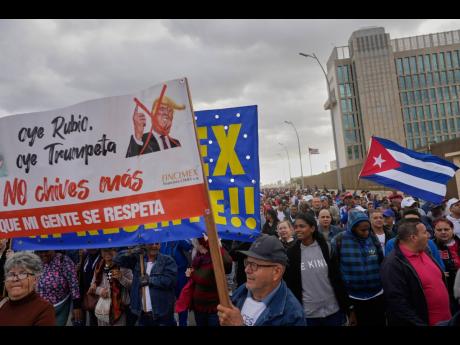
This column addressed in several articles this Trump Administration’s declared position on the Western Hemisphere and its activities in the Caribbean, including the removal of President Nicolás Maduro from Venezuela. Following the Venezuela mission, speculation has been on which country will be next on the US’s agenda. It was expected that Cuba would be in the crosshairs. The Secretary of State and National Security Advisor, Marco Rubio, is a child of Cuban émigrés and grew up in the Cuban immigrant community in Florida, which is rabidly opposed to the Cuban Communist regime. It is known that an ambition of the Secretary of State is to preside over the demise of the Cuban regime. President Trump, maybe jokingly, one is not sure, suggested that Secretary Rubio could be President of Cuba.
The fall of President Maduro left Cuba vulnerable. Venezuela supplied about 33 per cent of its oil needs. The rest, about 58 per cent, came from Mexico, Russia and other countries. Many are possibly not aware that Cuba has domestic oil reserves and produces about nine per cent of the oil it uses. Cuba has also developed and is continuing to develop renewable sources of energy with the aim of increasing this to 24 per cent of energy needs by 2030.
President Trump has threatened to impose more tariffs on any country which now supplies oil to Cuba. This is a threat to deny access to critical oil to Cuba, thus strangling its economy.
Cuba’s tragedy
Cuba had the misfortune of falling under US influence following the 1898 Spanish-American War. A reading of Cuba’s history in this period reveals that life was not rosy for the majority of Cubans. Cuba was granted independence from Spain in December 1898. It was under US military occupation until 1902 when it was granted full independence. That came with a proviso that the USA could interfere at will in its affairs, and they did. It was said that in some decades, the US Ambassador was more important than the Cuban President in office. A revolution was effected from 1953 to 1959 led by Fidel Castro, perhaps turned in Castro’s favour by the US administration’s ill-advised actions. Castro’s assumption to power, initially recognized by the USA, soon soured with the US which did not like Castro’s reforms. In February 1962, the US government imposed a near total trade embargo on Cuba, now strengthened by the 1996 Helms-Burton Act. The Cuban regime, for its survival, deepened relations with friends in other places, such as the Soviet Union, and resorted to its own ingenuity.
It would not be until 2015 that the USA and Cuba would resume diplomatic relations and President Barack Obama would be the first US President since 1928 to visit. It appears that the Vatican had some involvement in this short-lived rapprochement.
The hypocrisy, though, is that the USA has maintained normal relations with other countries which are not democracies and market economies.
The Cuban people are again facing severe economic challenges. It is reported that Cuba and the USA are in dialogue.
CARICOM AND CUBA
On December 8, 1972, Cuba and CARICOM established diplomatic relations. CARICOM/Cuba Day is marked annually on that date. On the 53rd anniversary of CARICOM/Cuba relations in 2025, the statement from CARICOM reads in part:
“ ... That bold act of 8 December 1972 has evolved steadily into a fruitful and mutually beneficial friendship between all CARICOM Member States and Cuba. Since that landmark date, the friendly and close relationship that unites CARICOM and Cuba has become an admirable demonstration of South-South Cooperation. Our partnership has been strengthened by regular bilateral meetings, eight (8) Summits and six (6) Ministerial Meetings. The Ninth CARICOM-Cuba Summit, to be held in Havana in March 2026, will provide another opportunity for an exchange on a wide range of bilateral, hemispheric and global issues that are of mutual interest and concern, as well as on areas for further cooperation, including trade, education and public health ...”
So now, what next?
On a Catholic note, Our Lady of Guadalupe, patron of the Americas, intercede for us.
Elizabeth Morgan is a specialist in international trade policy and international politics. Send feedback to columns@gleanerjm.com.