Hanover still struggling to recover
Loading article...
-
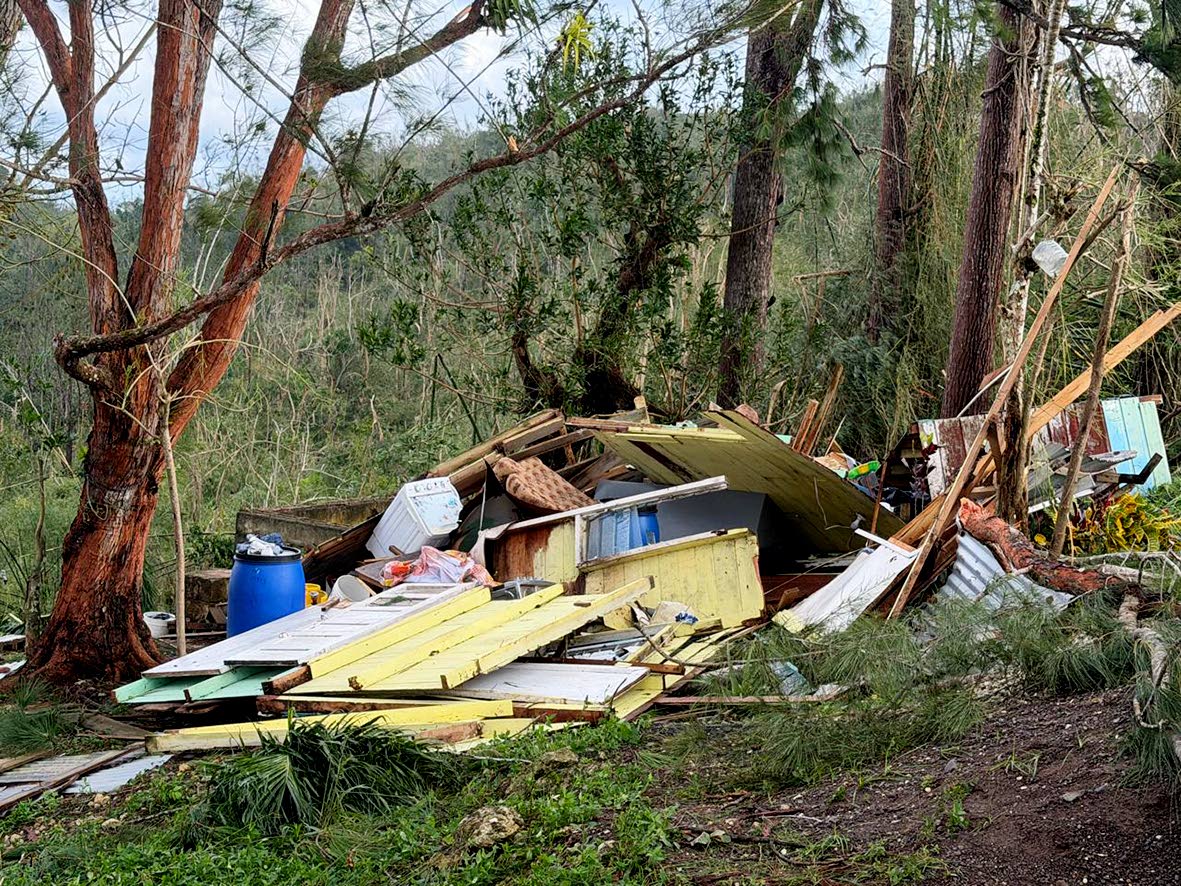 The mangled remains of a house that was destroyed by Hurricane Melissa a year ago. Photo - Bryan Miller
-
The mangled remains of a house that was destroyed by Hurricane Melissa a year ago. Photo - Bryan Miller
-
 One year after Hurricane Melissa, this house remains uninhabitable.
Western Bureau:
When Hurricane Melissa made landfall in Jamaica last October, Hanover was among the parishes hardest hit. Homes, farms and critical infrastructure were extensively damaged, and in some cases destroyed, by the Category 5 storm.
In communities such as Chester Castle in eastern Hanover, the effects remain evident a year later as residents continue to rebuild their lives.
“During the hurricane, houses, roads, schools, churches and health centres among other personal belongings were severely affected, in some cases completely lost, with several of the residents experiencing severe trauma and stress, from then even up to today,” recalled Councillor Wynter McIntosh, who represents the Chester Castle Division in the Hanover Municipal Corporation.
According to McIntosh, roads such as the Shettlewood-to-McField roadway, which suffered extensive damage during the storm, remain in a deplorable state.
“Several other inland roads were badly scoured because of the hurricane, and they all remain in bad condition,” he said.
Housing remains another major concern.
McIntosh said many damaged homes remain largely unchanged a year later. While some residents have received assistance, many are still waiting.
“In terms of homes, a lot of persons were affected, some suffering varying degrees of damage, while others were completely destroyed and, while some persons have gotten some government and private assistance, there are still persons in the area who are living under tarpaulin as we speak,” he said.
He added that many residents are frustrated because, despite having their homes assessed by the Ministry of Labour and Social Security, they have yet to receive assistance.
“A lot of small businesses remain closed up to today, as the owners do not have the financial resources to re-establish their businesses, and they have not received any assistance,” he said.
“My biggest concern remains the number of persons who have lost their homes and are still relying on relatives and friends for shelter.”
Greatest need
Andrea Purkiss, member of parliament for Hanover Eastern, echoed those concerns, saying the greatest need remains building materials for reconstruction.
“Right now, the greatest need is still housing materials, that are needed by the people. I still get calls every day from residents that were affected, seeking assistance to rebuild or repair their homes,” said Purkiss.
“Some of them started to try and help themselves but do not have the wherewithal to complete what they started.”
Purkiss also questioned the pace of assistance under the Government’s Restoration of Owner or Occupant Family Shelters (ROOFS) programme, noting that many residents who were assessed are still awaiting support.
“There are still many persons in this constituency who have not yet recovered at all, and are still in need of assistance,” she said.
“While we hear the word resilience, almost to the point where it has no meaning anymore, there are persons who have stated that they are no longer resilient, as they are in dire need.”
Last week, Prime Minister Dr Andrew Holness announced an additional $2 billion for the ROOFS programme amid mounting complaints that many Hurricane Melissa victims had yet to receive assistance.
Speaking at a housing handover ceremony in York Bush, Mount Carey, St James, Holness said that more than half of the approximately 115,000 households assessed had already received grants.
“... There still remains a significant number of persons who, to this date, have not yet received a grant, and it is creating - I know, I am aware - significant frustration, and I can understand,” he said.
The criticism has been even sharper in Hanover Western, where Member of Parliament Miller-Bennett said some communities still show few signs of recovery.
“Not much has happened in terms of help coming to the area. People are still living under tarpaulin-covered structures, small businesses are yet to recover, road breakaways remain visible across the constituency, the general bad road condition remains, and families are still facing difficult living situations,” she told The Gleaner.
She also criticised the ROOFS programme, arguing that its implementation has left many vulnerable residents without support.
“I would classify the ROOFS programme as an absolute failure in terms of how it was administered and rolled out in this area. Many persons who are in dire need of assistance are still left wanting, as they have not received any assistance through that programme,” she said.
Residents in communities such as Askenish and Riverside shared similar views, describing the programme as a disappointment.
“ROOFS seems to have bypass this section of Hanover, as we here still waiting for the help that was promised,” one resident, speaking on behalf of several neighbours, told The Gleaner.
“If we had gotten another hurricane this year under the existing conditions, trust me, dog woulda nyam we supper.”
According to Miller-Bennett, several residents publicly identified as beneficiaries during a visit by Local Government Minister Pearnel Charles Jr are still awaiting assistance.
“When the minister came to Hanover and had that ceremony, I was also asked to provide a list of persons to benefit, persons who were severely affected by the hurricane. Those persons were there, they were brought on stage, and they were presented with symbolic cheques and their pictures taken, and, to date, they have not received anything,” she said.
Miller-Bennett, who described the ROOFS programme as a “farce”, expressed gratitude to private-sector groups, both locally and in the diaspora, that stepped in to assist many affected residents.
Looking ahead, she said the Government must prioritise the rehabilitation of critical infrastructure to ease the burden on communities.
“We must prioritise our critical infrastructure, such as roads, and the breakaways, drainage systems, bridges because they affect general access, and things left undone only gets worst,” she said.
editorial@gleanerjm.com