Mico conference urges rethink of inclusive education
Loading article...
-
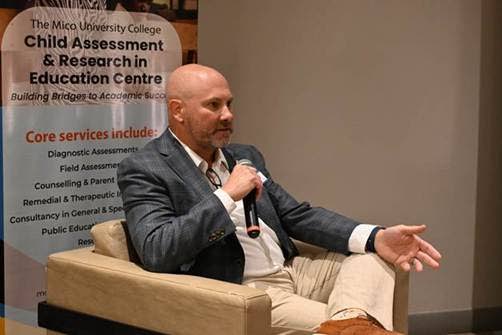 Dr James Basham, professor of special education, University of Kansas, at the Fireside Conversation held at AC Hotel in St Andrew on October 14. Photo - Contributed
-
Dr James Basham, professor of special education, University of Kansas, at the Fireside Conversation held at AC Hotel in St Andrew on October 14. Photo - Contributed
-
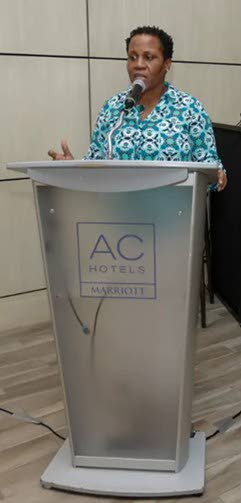 Dr Sharon Anderson-Morgan, director, Mico CARE Centre, giving opening remarks at the Fireside Conversation last week. Photo - Contributed
-
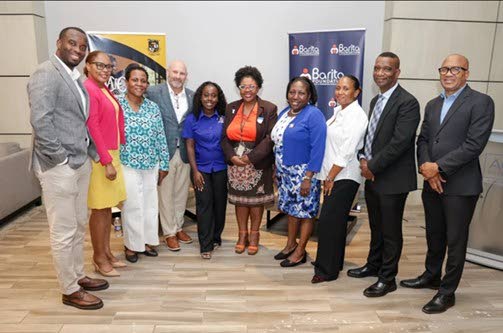 From left: Ricardo Allen, CEO, One on One Educational Services Ltd; Dionne Gayle-Smart, assistant chief education officer, special education at the Ministry of Education; Dr Sharon Anderson-Morgan, dIrector of Mico CARE Centre; Dr James Basham, professor of special education, University of Kansas; Chris-Ann Douglas, moderator for the session and Mico CARE special educator; Dr Nadine Simms, assistant chief education officer, Media Services Unit, Ministry of Education; Gunter Gayle, director, Early Stimulation Programme, Ministry of Labour and Social Security; Tanketa Chance-Wilson, executive director, Barita Foundation; Dr Asburn Pinnock, president, Mico University College and Andrew Lee, CEO, eLearning Jamaica Ltd,at the Fireside Conversation kick-start to the Ninth Biennial Education Conference held at the AC Hotel last week. Photo - Contributed
Educators have been urged to rethink how teachers are prepared, how student achievement is measured and how technology is used to support children with diverse learning needs, as stakeholders gathered for a discussion on the future of education in Jamaica.
The two-hour fireside conversation, hosted by The Mico University College Child Assessment and Research in Education (CARE) Centre at AC Hotel last Wednesday, opened activities for the institution’s ninth biennial education conference.
The discussion, held under the theme ‘Reimagining Learning for a Changing World: Inspire. Innovate. Impact’, brought together Ministry of Education officials, technology providers, educators, parents, advocates and other stakeholders.
Keynote speaker Dr James D. Basham, professor of special education at the University of Kansas and director of the Center for Innovation, Design, and Digital Learning, said education systems needed to recognise the differences among learners and design classroom environments to accommodate their needs.
Basham introduced Universal Design for Learning, a framework that considers learner variability when planning instruction. He challenged the traditional division between special and general education, arguing that schools should focus on ensuring that every child receives the support needed to learn.
“We’ve decided that some kids go on with special education, and some kids go on with what we call general education. But in reality, kids are kids,” he said.
“What if we were all in one system? What if every individual student got their needs met at the point of learning? And then, how would it have changed the way that we shape and prepare teachers?”
He argued that teachers should be trained to design learning environments that respond to students’ individual needs, rather than simply follow prescribed practices that may not work for every child.
Recalling an exchange with a teacher who described herself as “just a teacher”, Basham said he reminded her: “You are the architect of the environment.”
SPECIAL EDUCATION NEEDS
Dionne Gayle-Smart, assistant chief education officer responsible for special education at the Ministry of Education, Skills, Youth and Information, said the education system was experiencing a significant increase in the number of students presenting with autism and other complex needs.
“I think we are entering a new paradigm where we are seeing a significant increase in students presenting with autism …” she said, adding that the ministry was “really extremely busy” responding to the demands.
Gayle-Smart outlined several measures being pursued to support students, including the formal designation of classroom aides as Special Education Needs Assistants (SENAs). She said a special education policy was in draft and that special education units in primary schools were being extended to provide support throughout a child’s primary-school years, rather than limiting intervention to two years.
Dr Nadine Simms, assistant chief education officer in the ministry’s Media Services Unit, outlined the ministry’s artificial intelligence pilot and highlighted its partnership with UNICEF to produce accessible digital textbooks.
AI AND SCREEN TIME
Andrew Lee, chief executive officer of eLearning Jamaica Company Limited, discussed a platform being piloted in mathematics and English that is intended to reduce teachers’ marking workload and allow them to spend more time working directly with students.
The platform, he said, would allow teachers to spend less time marking and more time “hands-on with the students, which is what we are always looking for”.
Basham said artificial intelligence could help educators identify patterns in classroom data that might otherwise go unnoticed. However, he cautioned that the information needed to be interpreted carefully.
Even if AI could detect disengagement, he asked: “What threshold is engagement good versus bad?”
He also challenged the assumption that screen time was inherently harmful to learning, arguing that its impact depended on how technology was used.
“It’s not about the age that kids are using the screens. It’s about how they’re using the screens,” he said.
Mico President Dr Asburn Pinnock said balance would be essential as technology became increasingly central to education.
“What I’m hearing from you is balance. It’s like a balance of the ecosystem. … I think balance is the only way we can strive,” Pinnock said.
“Balance is critical for life,” Basham agreed.
EXAMINATION CHALLENGE
Professor Carmel Roofe-Bowen, director of the School of Education at The University of the West Indies, Mona, raised concerns about teachers struggling to apply lessons from their training because of the demands of a structured and regulated examination system.
Basham described the challenge as what design theorists call a “wicked problem” — one that can be managed but has no simple solution.
He said the way student achievement is measured was critically important, warning: “We are setting kids up to fail.”
However, he stressed that assessment remained necessary.
“We need to measure learning,” he said.
The discussion highlighted the challenge of reconciling examination requirements with the need to accommodate differences in how children learn.
PARENTS, DEAF EDUCATION
Tamar McKenzie, president of the Jamaica Independent Schools Association, who participated as both an educator and a parent, said the quality of care was often a major concern for parents of children who were struggling.
She said Jamaica had made “astronomical strides” over the past decade but argued that parents needed more opportunities to engage with experts and receive guidance on their children’s educational needs.
Kimberly Marriott-Blake, chief executive officer of the Jamaica Association for the Deaf, raised concerns about how to advise parents on deaf education when the system rewards mainstream placement.
Basham acknowledged that such decisions were not straightforward.
“There’s not a right answer to that,” he said, noting that placement should be determined by what best meets each child’s needs.
EVERY CHILD CAN LEARN
Dr Sharon Anderson-Morgan, director of the Mico CARE Centre, said the fireside conversation was intended to provide a space for stakeholders to exchange ideas, ask questions and learn from one another. The session was moderated by Chris-Ann Douglas, a special educator at the centre.
In closing, Basham said that as he read about Jamaica, he repeatedly encountered one central message: “Every child can learn. Every child must learn.”
The challenge, he said, was ensuring that the message reached children as well as adults.