Peter Espeut | Can leopards change their spots?
Loading article...
-
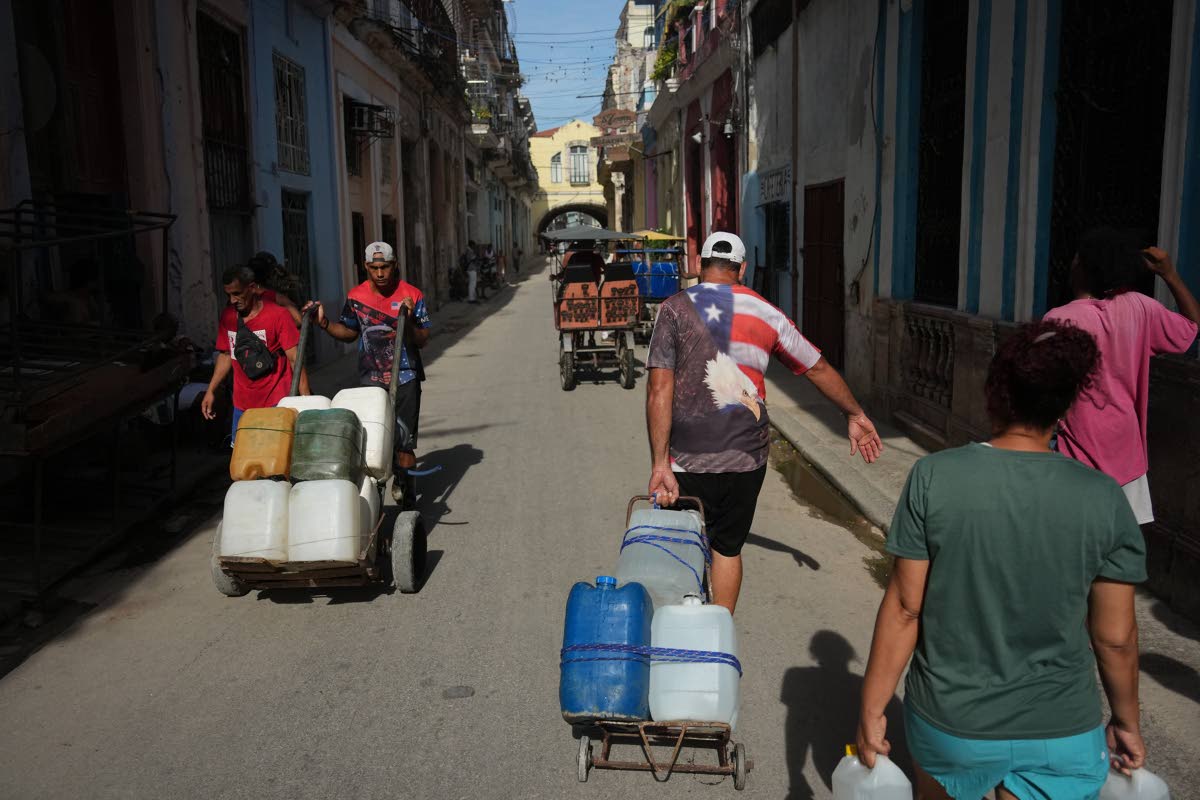 People carry water during a power outage in Havana, Cuba. Photo - AP
-
People carry water during a power outage in Havana, Cuba. Photo - AP
-
 Peter Espeut. Photo - File
Knowledge of history provides insights into the present and peeks into the future. I hope this little excursus is of interest.
In 1823, James Monroe, the fifth US president (1817-1825), declared US hegemony in the Americas by enunciating the Monroe Doctrine. Monroe declared that the US would not tolerate further efforts by European powers to retake or expand their colonial holdings in the Americas.
In the 1850s, slavery was legal in the US, but pressure for emancipation was mounting. As the US expanded westward and slavery-free western states were admitted to the Union, pro-slavery states were becoming increasingly outnumbered. Southern slaveholders therefore sought new slave-holding territories to join the US in order to strengthen the pro-slavery influence in Washington.
The annexation of Cuba had long been a goal of US expansionists. John Quincy Adams, the sixth US president (1825-1829), and Thomas Jefferson, the third US president (1801-1809), expressed great interest in Cuba, with Adams observing, while secretary of state (1817-1825), that it had “become an object of transcendent importance to the commercial and political interests of our Union”. He later described Cuba and Puerto Rico as “natural appendages to the North American continent”. Annexation, he argued, was “indispensable to the continuance and integrity of the Union itself”.
US ambassadors in Europe, Pierre Soulé (Spain), James Buchanan (later the 15th US president) for Britain, and John Y. Mason (France), met secretly in Ostend, Belgium to discuss a strategy for acquiring Cuba. The document they drafted, the Ostend Manifesto, declared that the US would be “justified in wresting” the island from Spain in the name of national security if Spain refused to sell it (Greenland beware!).
The existence of the Ostend Manifesto was leaked, and Congress demanded its publication. The manifesto was immediately denounced in both Europe and the northern United States. Cuba’s annexation was shelved.
Jamaica was a staging point for the Cuban War of Independence. Both José Martí and Antonio Maceo lived in Jamaica for a time and organised support among Cuban exiles in the tobacco industry on the island. It is likely that the flag of independent Cuba was first sewn by Cuban women working on the tobacco farm at Temple Hall, St Andrew. Two photographs exist of Martí at Temple Hall in 1892 among his compatriots with the flag.
‘Juntas’ of Cuban exiles were organised in several places, including Jamaica, to plan and raise funds for the War of Independence. Martí lobbied against the US annexation of Cuba. James Gillespie Blaine, US secretary of state (1889-1892), had predicted that all of Central and South America would someday fall under US control (a process some might argue is still unfolding).
The insurrection began on February 24, 1895. Fighting was most prominent in Oriente, where the campaign went well, though less so elsewhere. General Martí was killed on May 19, 1895, but General Maceo fought on.
In mid-September, representatives of the liberation forces assembled in Camagüey and established a central government. The liberation armies continued to outmanoeuvre the enemy.
The Spanish sent a new army chief, General Valeriano Weyler y Nicolau, who launched a campaign of terror. On October 21, 1896, he announced that rural Cubans had eight days to relocate to concentration camps; all who did not would be considered rebels and shot. Hundreds of thousands of people were forced to leave their homes and endure appalling conditions in crowded camps. Between 155,000 and 170,000 civilians died, nearly 10 per cent of the population.
Maceo was killed on December 7, 1896, in Havana Province. In 1897, the liberation army maintained a strong position in Camagüey and Oriente. The rebel force defeated the Spanish in various encounters, including forcing the surrender of Las Tunas in eastern Cuba on August 30. A Cuban nationalist administration was slowly taking power.
The Cuban struggle for independence captured the imagination of the US public. Some newspapers agitated for US intervention, particularly because of the country’s substantial financial investments and the Spanish atrocities committed against Cubans.
In January 1898, Spanish loyalists rioted in Havana against the new government. The US consul general cabled Washington expressing fears for the lives of Americans living in Havana. In response, the battleship USS Maine was sent to Havana. On February 15, 1898, the ship was rocked by an explosion that killed 261 crew members and sank the vessel in the harbour. A military board concluded that a mine had detonated beneath the hull, and Spanish forces were blamed. Later investigations determined that the ship’s magazines had likely been ignited by a spontaneous fire in a coal bunker.
The sinking of the USS Maine sparked public indignation in the US. On April 11, 1898, President McKinley asked Congress for authority to send troops to Cuba. On April 19, Congress passed joint resolutions demanding Spanish withdrawal, supporting Cuban independence, disclaiming any intention to annex Cuba, and authorising the president to use military force to help Cuban patriots gain independence from Spain.
This included the Teller Amendment, which passed unanimously and stipulated that “the island of Cuba is, and by right should be, free and independent”. The amendment disclaimed any intention by the US to exercise jurisdiction or control over Cuba, except for pacification purposes, and confirmed that US armed forces would be withdrawn at the conclusion of the war.
Hostilities began immediately. US Navy ships blockaded several Cuban ports. The US decided to invade Cuba through Oriente, where Cuban nationalists had almost complete control. They cooperated by establishing a beachhead and protecting the US landing.
The US fleet needed shelter during the summer hurricane season. Nearby Guantánamo Bay, with its excellent harbour, was selected and attacked on June 6. The Battle of Santiago de Cuba on July 3, 1898, destroyed the Spanish Caribbean Squadron.
Thus, Oriente came under the control of US forces, but the Americans would not allow Cuban troops to enter Santiago or participate in the surrender ceremonies. Although the Cubans had fought in the liberation war, indeed had initiated it at the cost of the lives of Maceo, Martí and thousands of others, the US portrayed the outcome as though it alone had liberated Cuba.
The US prevented Cuba from participating in the Paris peace talks and the signing of the Treaty of Paris on December 10, 1898, between the US and Spain. The treaty ceded Cuba to the US rather than granting independence to Cuba. It was a betrayal of the Cubans.
Even though the US Congress had not explicitly authorised it, the US used the war with Spain to seize several other Spanish possessions, namely the Philippines, Guam and Puerto Rico. The US now possessed colonies and had become a world power.
Although Spain had been expelled, US troops remained in occupation. Cuba was not officially declared independent until the US occupation ended in 1902, but it remained a virtual US protectorate (How goes Venezuela?). Real independence was yet to come.
Belated Happy Independence, Jamaica!
Peter Espeut was the former vice-president of the Jamaica Historical Society. Send feedback to columns@gleanerjm.com