Norris R. McDonald | Wage theft: Stolen wages, stolen dreams
Loading article...
-
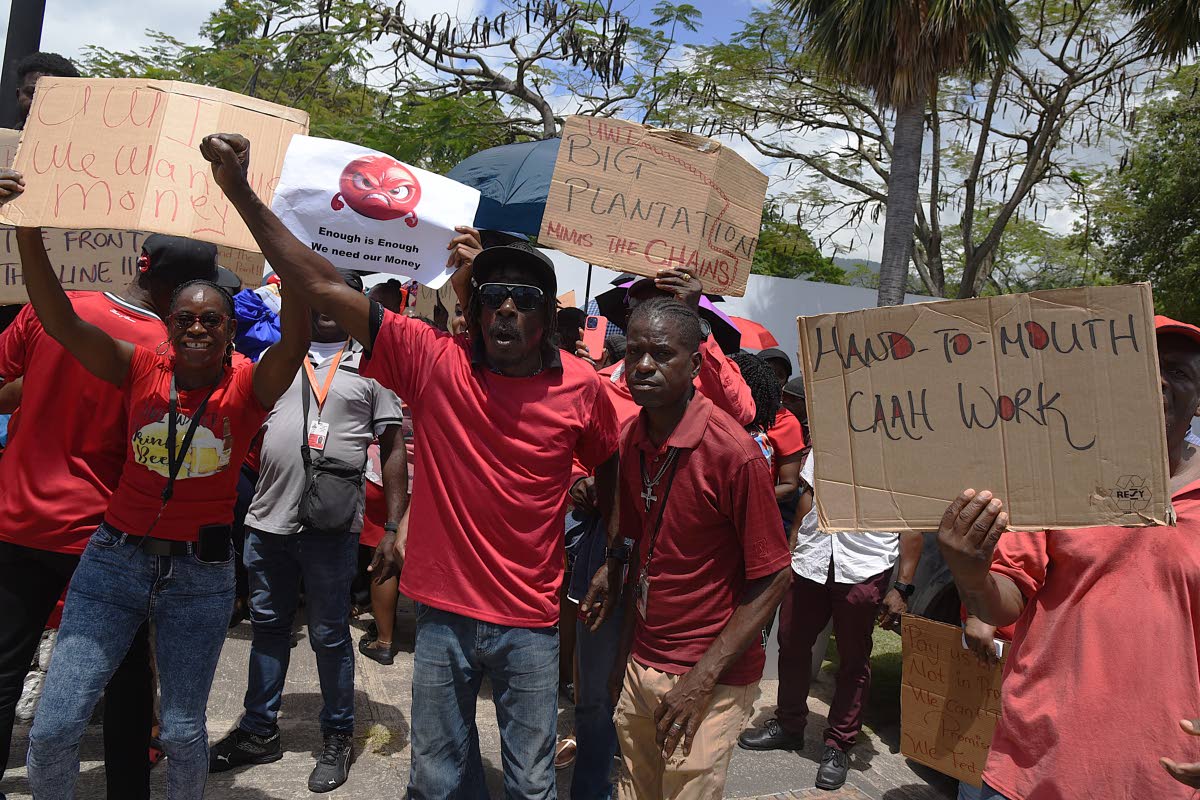 Employees at both the University of the West Indies (UWI) and University Hospital of the West Indies (UHWI) demonstrated outside the gates of the UWI for better wages on Wednesday. The vowed to continue their protest until they are told when they will see the improvement in their wages which was promised by Dr. Nigel Clarke while he was the Minister of Finance.
-
Employees at both the University of the West Indies (UWI) and University Hospital of the West Indies (UHWI) demonstrated outside the gates of the UWI for better wages on Wednesday. The vowed to continue their protest until they are told when they will see the improvement in their wages which was promised by Dr. Nigel Clarke while he was the Minister of Finance.
-
 Norris R. McDonald
I was terrified as I ran for my life down Princess Street in downtown Kingston in the late 1960s. Behind me was the owner of a notorious hire-purchase furniture store, chasing me with a big stick after refusing to pay me my week’s wages.
I had worked one exhausting week, Monday to Friday, from 7 a.m. until 11 p.m. When I returned on Saturday morning to collect my wages, the employer ordered me to clean his adjoining rum bar.
I refused and demanded my hard-earned wages. Instead of paying me, he reached for ‘a rahtid big stick’ and chased me down Princess Street.
Yes!
I escaped the beating!
But not the theft!
More than half a century later, I still remember one terrifying thought as I ran:
“My life is worth more than this money!”
That ‘big-stick chase’ remains one of the most vivid memories of my youth. It was also my first encounter with what I would later learn was called wage theft. More importantly, it reinforced my lifelong belief in justice, fairness and the dignity of labour—values deeply rooted in my Coromantee Garveyite family.
LIFE LESSONS FROM WAGE THEFT
My friends, a few years later I joined the Ministry of Labour and Employment, first in the Minimum Wage Branch and later in the Overseas Employment Division. There, as a young civil servant, I listened almost daily as industrial and overseas workers described terrible working conditions, unpaid wages, illegal deductions, delayed earnings and other cruel forms of exploitation.
My own experience of wage theft, together with years of listening to workers recount their ordeals, left a lasting impression on me.
I began to see the bigger, the uglier picture that wage theft was a deep-rooted problem woven into the fabric of our society.
As the Jamaica Gleaner reminded us in its February 20, 2020 edition, former Labour Minister Hon J.A.G. Smith and Permanent Secretary Probyn Aitken were convicted and imprisoned in 1990 on corruption charges arising from the United States Farm Work Programme.
That scandal shone a spotlight on one of the most corruption-prone areas of public administration, where workers were exploited by foreign employers, local businesses, and even Jamaican public officials entrusted with protecting them.
Sadly, the culture of corruption has not vanished. Shameless corruption — including wage theft in its many forms — still appears to be worn like a badge of honour.
STOLEN WAGES, STOLEN DREAMS
Wage theft occurs whenever employers fail to pay workers the wages they have legally earned. Today, however, labour exploitation often extends far beyond straightforward payroll violations.
Wage theft is widespread in the United States, Canada, the United Kingdom and elsewhere. Employers illegally withhold billions of dollars every year through unpaid overtime, minimum wage violations, unpaid meal breaks, and other unlawful employment practices.
Having experienced the theft of my wages by an unjust employer — and after many years listening to workers’ frustrations — I know that the psychological consequences can be devastating.
Stolen wages are not merely stolen income. They become stolen opportunities, stolen dignity, and stolen dreams.
Every dollar stolen from a worker is taken from a child’s education, a family’s nutrition, rent, medical care, a mortgage payment or a community’s future.
Workers who experience wage theft frequently suffer anxiety, depression, chronic stress, shame and uncertainty. Financial insecurity strains families, disrupts children’s education, and undermines physical and mental health.
Research also links wage theft and chronic financial stress to burnout, poorer health, reduced productivity, and increased workplace injuries. Workers living under constant financial pressure are more vulnerable to fatigue, distraction and accidents.
STRUCTURAL WAGE THEFT’: THE IMPERIALIST FORM OF EXPLOITATION
For Black people throughout Africa, the Caribbean, Latin America, North America, Europe and beyond, labour exploitation did not begin with the modern workplace. It stretches back over more than three centuries of slavery and colonial domination.
African labour generated immense wealth for the colonial powers while we Black people were systematically beaten down, dispossessed and held back by Babylon.
Slavery was the ultimate form of labour theft.
Although formal colonialism has ended, its economic legacy lives on. Crushing debt, unequal trade rules, capital flight and financial dependence continue to keep many developing countries at a disadvantage. The methods have changed, but the struggle over who benefits from workers’ labour has not.
Jamaica is a clear example. For decades, governments have implemented International Monetary Fund (IMF) programmes that have restrained wages, weakened labour protections and reduced workers’ purchasing power.
As currency devaluations, wage restraints and rising prices erode the value of wages, profits and debt repayments remain protected. The result is that working people create more wealth but receive less in return.
In its essence, IMF prescriptions are a modern form of structural wage theft, that transferring wealth from workers to powerful local elites and international financial interests while ordinary black Jamaicans struggle to make ends meet.
My dear friends, history shows that fairness is rarely given; it must be organised, demanded and defended. That is why the struggle for decent wages, secure jobs, strong trade unions and economic justice remains as relevant today as it was in the days of slavery, colonialism and the fight for national independence.
Therefore, whether confronted by an employer with a big stick, as I was, or by the crushing weight of this oppressive Babylon economic system, workers cannot simply assume they will receive a fair day’s pay for a fair day’s work.
Now, more than 50 years later, as I look back, I still remember running down Princess Street. I escaped the beating, but not the lesson.
Wage theft is never just about money. It steals dignity. It steals opportunity. It steals hope.
Every honest day’s work deserves an honest day’s pay. But let us never assume that justice comes automatically. Workers have always had to organise, demand accountability and defend their rights.
As Bob Marley and Peter Tosh reminded us:
“Get up, stand up, stand up for your rights.”
That is just the bitta truth.
Norris R. McDonald is an author, economic journalist, political analyst and respiratory therapist. Send feedback to columns@gleanerjm.com.