Bringing brain care home
Loading article...
-
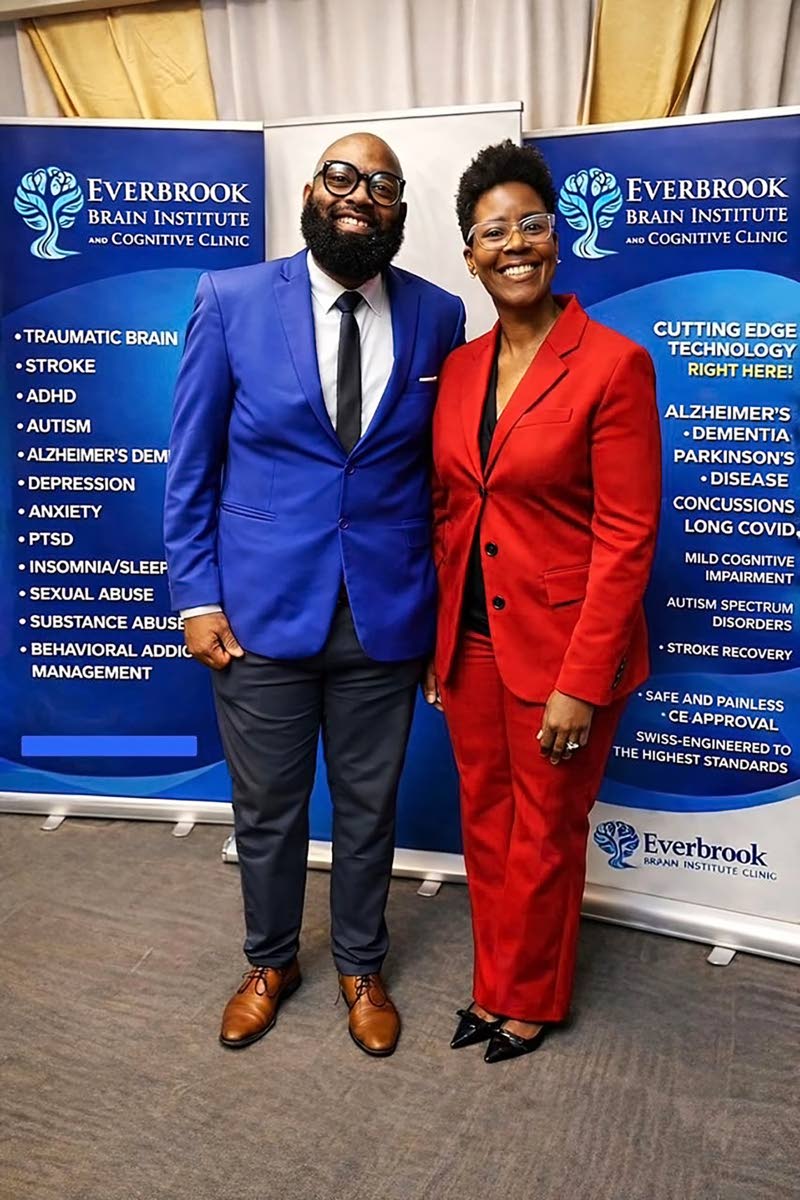
Dr Francene Gayle, consultant stroke neurologist, and her husband, Dr Steve Lawrence, an expert in technology, curriculum, eLearning, artificial intelligence, and research, are the co-owners of Everbrook Brain Institute & Cognitive Clinic, located at 80 Musgrave Road in St Andrew.
-

-
Jamaica’s push to expand advanced neurological care is getting a boost from the return of a locally trained specialist, whose new facility is aiming to reduce the need for patients to seek treatment overseas.
For Dr Francene Gayle, the move was not simply a homecoming. It marked the beginning of a deeply personal mission to help close one of the country’s most pressing healthcare gaps, access to specialised brain care, particularly for patients and families confronting Alzheimer’s disease and other forms of dementia.
That mission has since taken shape in the Everbrook Brain Institute and Cognitive Clinic, a division of Everbrook Limited. The facility, Gayle said, was born out of faith, vision, sacrifice, and a determination to ensure that Jamaicans do not have to look abroad for every specialised brain health service.
Gayle, the clinic’s chief executive officer and consultant stroke neurologist, explained that Everbrook’s vision did not emerge from a traditional business plan. Instead, it began in 2021 while she and her husband, co-founder Dr Steve Lawrence, were living overseas during the COVID-19 pandemic.
“We had no intentions of returning to Jamaica at that time,” she said, noting that the name Everbrook was drawn from Psalm 1:3: “like a tree planted by the river.”
At the time, Gayle was already operating at a high professional level.
“I helped lead the Bermuda Hospitals Board to the highest level of international accreditation for stroke centres in the world and had also served on adjunct staff at Johns Hopkins School of Medicine,” she said.
Even so, she felt compelled to pursue further training in Canada as a stroke neurologist.
“This one was difficult, because as far as I was concerned, I had conquered all of that knowledge, but in obedience to God, I went,” Gayle said.
Lawrence, then deputy principal and technology director in Bermuda, recalled the moment.
“Imagine living your dream on a wonderful island, having your job, an amazing church family and friends, everything you could possibly dream of. And then my wife comes and says, it is time for us to go back to Canada. To be honest, initially, that was not the greatest news to hear. But answering a call from God is always best.”
PROFESSIONAL STABILITY
After completing her stroke fellowship, Gayle secured a rare full post as a stroke neurologist in Canada, signalling professional stability for the couple.
But even then, they believed they were being called back to Jamaica.
“On paper, we had everything. And then the call came to give it up,” Lawrence said.
Once back home, Gayle said one of the clearest assignments placed before her was to establish a brain institute grounded in cutting-edge technology and innovation, one that would allow a low- and middle-income country like Jamaica to access the level of care more commonly found in developed nations.
That vision led the couple to Germany and Switzerland, where they explored transcranial pulse stimulation, a non-invasive technology that uses acoustic waves delivered through the skull to stimulate targeted areas of the brain, now central to Everbrook’s services.
Lawrence approached the idea with caution rather than sentiment.
“I read the papers, I looked at the research, I crunched the numbers, I examined the blind studies. I even did a cross-sectional analysis. I was looking for anything I could poke a hole in to say, ‘You know what, let’s not do this’,” he said.
The more he studied the field, the more convinced he became.
“Eventually, I recognised that what they were doing in Thailand and in Switzerland is what we could be doing in Jamaica. That became the focus we needed to zoom in on.”
Their search led them to the CE-approved Neurolith system in Switzerland, a medical device designed specifically for transcranial pulse stimulation.
“When that machine finally got delivered to our location, it became the Everbrook Brain Institute and Cognitive Clinic officially,” Gayle said.
Its arrival, she added, brought clarity to the sacrifices made along the way.
“It made so much impact on why the sacrifices were necessary, why we had to do what we did. The machine arrived on time, and so we literally learned to trust the process.”
Everbrook officially launched on March 10, 2026, at the Development Bank of Jamaica (DBJ) as Jamaica’s first non-invasive brain stimulation clinic. The project was financed by JN Bank and the DBJ, and developed in partnership with Storz Medical and SWT Therapy Inc.
The clinic’s debut comes amid renewed global focus on dementia. Following the September 2025 United Nations General Assembly Fourth High-Level Meeting on Non-Communicable Diseases and Mental Health, dementia was, for the first time, explicitly recognised as a major public health priority in a new political declaration.
Everbrook’s introduction of the Neurolith system is a direct response to that growing need, positioning Jamaica within a wider shift toward research-driven, technology-supported brain care.
International experts at the launch reinforced that positioning.
Professor Ulrich Sprick, head of the Centre of Neurostimulation and Department of Research and Development at the Alexius/Josef Clinic in Neuss, Germany, said research using the Neurolith system has shown that transcranial pulse stimulation can significantly improve cognitive function –including executive function, and help ease depressive symptoms in patients with Alzheimer’s disease.
DEPTH OF RESEARCH
Dr Dilana Hazer Rau of Storz Medical AG, Switzerland, emphasised the depth of research behind the technology and its expanding clinical application.
“With our non-invasive shockwave technology, we see improvements in cognition, movement, and pain across Alzheimer’s, Parkinson’s, chronic pain, and women’s pelvic health,” she said.
“Our goal is to make these scientifically proven treatments accessible to more patients around the world, including here in Jamaica,” Hazer Rau added.
Supporters of the initiative also pointed to its wider implications for Jamaica’s healthcare system.
At the launch, DBJ Managing Director Dr David Lowe said, “Facilities like Everbrook can widen access to advanced therapies and reduce the need for overseas travel for certain specialised services.”
JN Bank Corporate Relations Manager Dr O’Neil Dacres described the centre as an important step in expanding how neurological conditions are treated locally.
Still, the personal sacrifices behind the project remain central to its story.
“This task also required us to sacrifice our financial freedom,” Gayle said.
Lawrence was equally candid.
“I love God. I love my wife. It was a tough one, because as a man, your role is to secure the family.”
Reflecting on the journey, he said he now better understands what it means to be planted by the river, trusting that when the fruit comes, it will be God’s doing, because “our greatest act of worship is obedience”.
For the couple, Everbrook Brain Institute and Cognitive Clinic is more than a business built to meet a need.
“It is a ministry,” Gayle said. “And like that tree in Psalm 1:3, we remain rooted by the river, trusting God to bring forth fruit in due season.”