Sweet sin tax
Loading article...
-
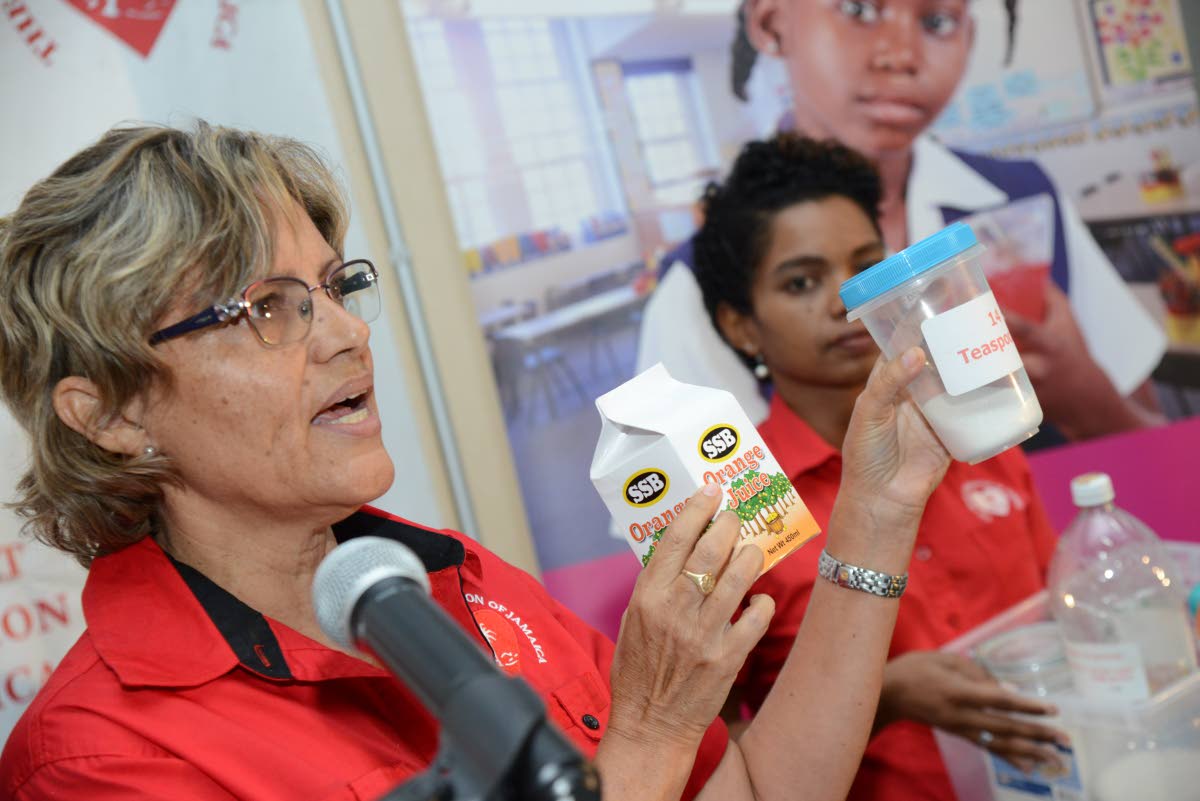
Deborah Chen (left), executive director of Heart Foundation of Jamaica, shows an example of a box drink and the equivalent sugar content, while Ponetta Nurse, advocacy officer of HFJ, looks on.
-
-
 Fayval Williams, minister of finance and the public service, tabling the Estimates of Expenditure for 2026-2027 in Parliament on Thursday.
The Government’s 2026-27 Budget has sparked a stark divide between public-health advocates celebrating a new sugary drink levy and industry leaders warning that it will hit low-income consumers hardest.
The Budget will lean on eight revenue measures that blend classic ‘sin taxes’, modernisation of the tax base, and the continuation of extraordinary flows from the National Housing Trust (NHT) as Government seeks to close fiscal gaps widened by back-to-back climate shocks.
At the centre of the Government’s 2026-27 revenue package is a new Special Consumption Tax (SCT) on non-alcoholic sweetened beverages, set at $0.02 per millilitre. The levy captures drinks with added sugar or artificial/non-nutritive sweeteners, whether locally produced or imported, and is projected to raise $10.1 billion in its first year. Examples of the price impact include $6 for a 300ml drink, $12 for 600ml, and $40 for a two-litre bottle.
The move has been labelled by industry and the political Opposition as regressive, meaning that it takes a larger share of income from poorer households.
Finance Minister Fayval Williams said the tax serves “broader public-health objectives” in a country grappling with obesity and diabetes.
William Mahfood, chairman of Wisynco, a premier Jamaican manufacturer and distributor of beverages and consumer goods, is pressing the Government for clarity and fairness on which beverages are affected.
He told The Gleaner that the definition appears to sweep in “all sweetened beverages … containing added sugar as well as artificial or non-nutritive sweeteners”.
Mahfood added the tax seems to treat low-sugar drinks the same as high-sugar drinks, which he equated to “taxing beer at the same level as rum”.
He wants policymakers to clarify whether low-sugar drinks face the same levy as high-sugar options, how powdered drink mixes, syrups, and bag juices will be treated, and whether the per-millilitre approach mirrors the alcohol regime’s link to content.
Mahfood argued the measure is “prejudicial” because it taxes sugar only in certain beverage categories while allowing other sweetened products – including pastries, cookies, ice cream and confectionery – to escape taxation.
He said if Government wants to reduce sugar consumption, “then tax sugar – in all its forms”.
This selective approach, in his view, unfairly targets beverages disproportionately consumed by lower-income groups, while sugar-rich foods consumed across income classes are exempt.
Above all, he warned, “This is effectively a tax on poor people – $10 billion coming out of the pockets of the average man on the street”.
But the news is being celebrated by Deborah Chen, executive director of the Heart Foundation of Jamaica (HFJ), who called it a “long-overdue win”.
The HFJ and its partners had long been campaigning for a tax on sugary drinks, most noably through the ‘Are You Drinking Youself Sick?’ campaign.
“Finally, public health has won,” she told The Gleaner yesterday. “Sugary drinks are a major contributor to obesity, diabetes, and tooth decay.”
Pointing to results abroad, she said: “With an increase in tax, … there is a reduction in the consumption of sugary drinks.”
She urged manufacturers to shift portfolios.“Continue to make profits, but on drinks that have less sugar or no sugar,” Chen said.
The sugary drink tax is part of a broader fiscal strategy designed to close gaps widened by back-to-back climate shocks, including Hurricane Melissa’s US$8.8-billion impact on the physical environment alone.
Williams told Parliament that “targeted revenue measures to strengthen revenue performance, safeguard fiscal sustainability, and ensure the Government’s continued ability to deliver essential public services are introduced”, noting that administrative fixes alone cannot bridge the post-Melissa holes.
For FY2026-27, the package is projected to deliver $29.439 billion, with main new inflows for FY2027-28 coming from digital and tourism GCT, totalling $15.6 billion.
Williams framed the budget as a balanced response to crisis while preserving commitments. “Today, my message is a message of hope … . We will rebuild,” she said, noting that the Government remained committed to public-sector wage offers and raising the income tax threshold to $1.9 million on April 1, 2026.
Opposition Spokesman on Finance Julian Robinson questioned the sugary drinks tax’s effectiveness in changing behaviour and urged part of the revenue be ring-fenced for healthier alternatives. He warned that the Government’s projected $10.1-billion take itself shows that it does not expect consumption to fall significantly, meaning the poorest will continue buying and paying more.
“I do not believe the price increases will change behaviour. The demand is relatively inelastic,” he said, recommending investment in unsweetened natural juices. He also highlighted the Government’s reliance on prior one-off transactions to balance budgets.
Tallying the take for Financial Year 2026-27, the measures are projected to deliver $29.439 billion – comprising $10.1 billion (SCT on sweetened beverages), $1.6 billion (alcohol SCT), $1.1 billion (cigarettes SCT), $1.3 billion (motor vehicle concession modification), $3.639 billion (EPL rate/base change), $0.3 billion (digital GCT, partial year), and $11.4 billion (NHT transfer). For FY2027-28, the main new inflows are $4.2 billion (digital GCT at full run-rate) and $11.4 billion (tourism GCT at 15%), for $15.6 billion in that year from those items.
neville.graham@gleanerjm.com
Key measures
• Digital economy taxation: Applying GCT to digital services and intangibles supplied from abroad, expected to yield $0.3 billion in FY2026-27 and $4.2 billion in FY2027-28. Williams said, “We are expecting $300 million in the first instance … As it is fully implemented in the financial year 2027-2028, we would expect $4.2 billion.”
• Traditional sin goods: SCT on pure alcohol rises from $1,230 to $1,400 per litre of pure alcohol, and SCT on cigarettes rises by $3 per stick to $20, both effective May 1, 2026. These changes are projected to generate $1.6 billion and $1.1 billion, respectively.
• Structural base-broadening: Modifications to motor vehicle duty concessions for certain public officials, raising $1.3 billion; and an increase in the Environmental Protection Levy from 0.5% to 0.8%, expanding coverage to 100% of domestic sales for $3.639 billion.
• Tourism GCT: The concessional rate will rise from 10% to 15% on April 1, 2027, expected to yield $11.4 billion annually.
• National Housing Trust transfer: Continued at $11.4 billion annually through FY2030-31, averting a sharp fall-off in revenues.