Dennis Minott | The software of integrity
Loading article...
-
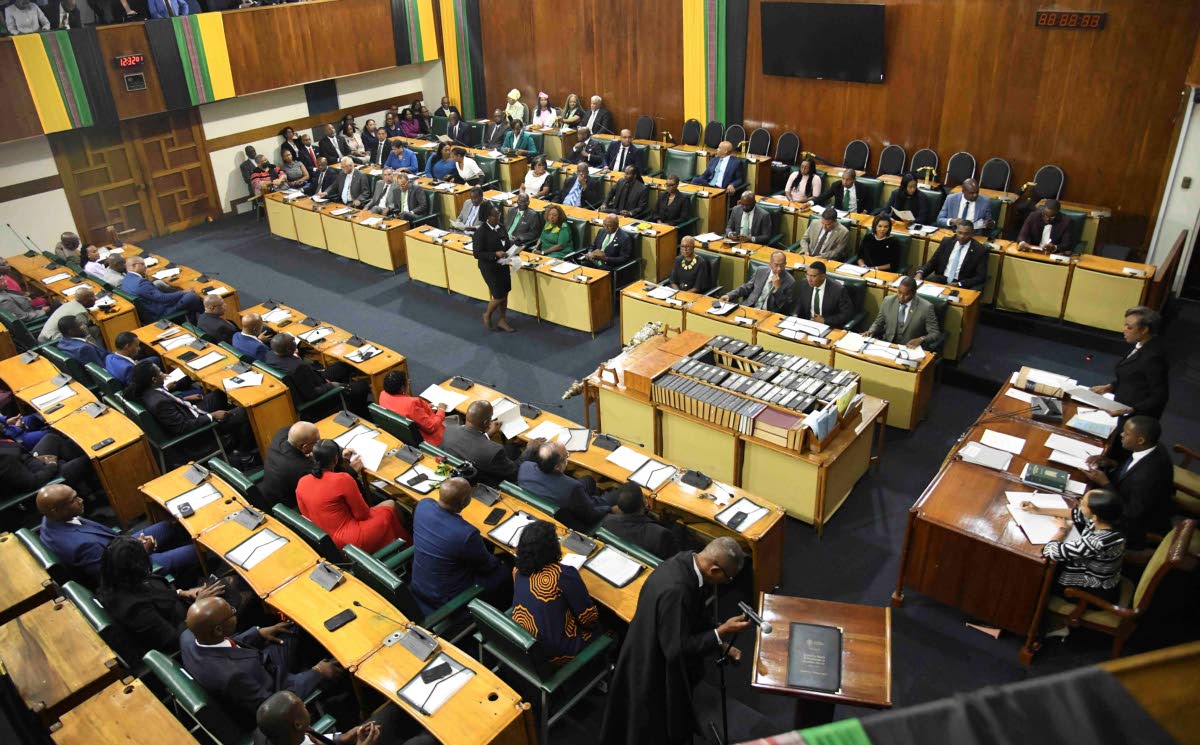 Members of Parliament before being swore at the swearing-in ceremony for members of the upper and lower houses of Parliament held on September 18, 2025 in Gordon House.
-
 Dennis Minott
The Jamaican landscape is often described in the binary of “hardware” and “software”. We excel at the hardware, the construction of highways, the expansion of hotel room counts, hospital building, and the drafting of complex legislative frameworks. Yet, as we survey the current state of Jamaica’s Cabinet, it is increasingly evident that our national progress is being throttled by a glitch in the “software”: the moral and corrective reflexes that should govern public life.
Moral ambiguity in the executive is not merely a matter of legal technicalities or the presence of the Integrity Commission; it is a fundamental crisis of accountability that threatens the very foundation of our social contract. When the “urgency of execution” becomes a shield for the “opacity of action”, the Jamaican citizen is left to wonder if the price of development is the abandonment of ethics. Get this: “I, yes, I, will do it again, and again Mrs Calder, and Mrs Narcisse”, promised the trumpian minister.
PERFORMANCE TRAP
The current administration has anchored its mandate in a “results-oriented” philosophy. On the surface, this is commendable. The SPEED Programme of 2025 and various infrastructure initiatives suggest a government in a hurry to modernise. However, a dangerous moral grey area emerges when “concrete performance” is decoupled from procedural integrity.
In the Cabinet rooms of 2026, there is an unspoken tension between the bureaucrat and the politician. The former is bound by the Financial Administration and Audit (FAA) Act, while the latter is often driven by the four-year electoral cycle. This tension often manifests as a dismissal of oversight as “bureaucratic inertia”. When a minister views the auditor general’s report (or JAMP) not as a corrective tool but as a political nuisance, the “hardware” of the state begins to rust-out from within.
We see this most clearly in the “accountability crisis” involving billions in unaccounted-for expenditure across key ministries. The defence is almost always administrative, a failure of filing, a turnover of staff, a legacy issue. But in the realm of moral leadership, “I did not know” is rarely a valid plea. A Cabinet minister is not just a manager of a portfolio; they are the fiduciary trustee of the people’s purse. To preside over a ministry where billions “vanish” into the ether of bad bookkeeping is, at best, a moral failure of diligence.
EROSION OF ‘SHAME TREE’
Historically, Jamaican society was governed by a powerful, albeit informal, moral compass, what some have called the “shame-tree”. It was the instinctive understanding that certain behaviours were simply “not done”. If a public official were caught in a conflict of interest, the resulting social and political pressure would necessitate a resignation. E.P.G. Seaga would shout “Amen” for that was the reason this writer, one of his trusty speech-writers, once gave for briefly serving in the JLP.
Today, that shame tree has been uprooted. We have entered an era of “brazenness and brass-face”. When reports from the Integrity Commission are tabled, they are frequently met not only with a wheezing asthmatic’s reflection on tar-like conduct, but with aggressive legal challenges or virginity2-claiming protestations of dismissive rhetoric. The moral ambiguity lies in the fact that our Cabinet of political leaders have mastered the art of being “legally right, but morally bankrupt.” They navigate the fine print of the law to avoid prosecution while trampling on the spirit of public trust. Delroy strains out pollen and Babsy swallows Tufton jackfruits whole.
This erosion is compounded by the “reward for loyalty” culture that defines our tribal politics. When a minister’s primary accountability is to ‘di pawti-leedah’ rather than the Parliament or the people, their moral compass inevitably points toward political survival rather than Jamaica’s national interest.
SHADOW OF VOTER APATHY
The most damning indictment of this moral ambiguity is not found in a court of law, but in the silence of the ballot box. With voter turnout hovering around the 30 per cent mark, the message is clear; the Jamaican people have developed a profound distrust of the system.
Politicians often misinterpret this apathy as contentment or a “silent mandate”. In reality, it is a withdrawal of consent. When the public perceives that the rules only apply to the small man, that a vendor is prosecuted for a lack of a permit while a minister evades questions on multi-million dollar contracts, the moral legitimacy of the state dissolves. We cannot build a “first-world” nation on a “fourth-world” ethical foundation.
HARDWARE OF LAWS VS SOFTWARE OF VALUES
We do not lack for laws. We have the Integrity Commission Act, the Ministerial Code of Conduct, and the Protected Disclosures Act. We have the “hardware”. What we lack is the “software”–the internalised values of Nolan’s Seven Principles of Public Life: selflessness, integrity, objectivity, accountability, openness, honesty, and leadership.
Confronting moral ambiguity requires a shift from “compliance” to “conscience”. It requires a Cabinet where collective responsibility is not a shield for individual misconduct, but a shared commitment to a higher standard. It requires the prime minister to act not just as a chief executive, but as a moral arbiter, willing to prune the Cabinet of those who prioritise personal or partisan gain over the public good.
CALL FOR RADICAL TRANSPARENCY
To clear the fog of ambiguity, we must move toward radical transparency. This means the immediate and unedited tabling of all oversight reports. It means a transformation of the “Declaration of Assets” from a private ritual into a public assurance of honesty. It means establishing a clear, non-negotiable consequence framework where administrative “errors” regarding public funds lead to immediate removal from office.
Jamaica stands at a crossroads. We can continue to celebrate our “hardware”–the roads, the bridges, and the digital systems–while ignoring the rot in our moral “software.” Or, we can choose to confront the ambiguity head-on. We must demand a Jamaica House Cabinet that understands that their greatest legacy will not be the buildings they leave behind, but the integrity they restore to the office they hold.
The “shame-tree” must be replanted. Not as a relic of the past, but as a living, breathing part of our modern democracy. Only then can we move from a state of “results at any cost” to a nation led by Most Honourables and Honourables of consistently noble deeds.” The moral health of Jamaica depends on it.
Dennis Minott, PhD, is the CEO of A-QuEST-FAIR. He is a multilingual green resources specialist, a research physicist, and a modest mathematician who worked in the oil and energy sector. Send feedback to: a_quest57@yahoo.com or columns@gleanerjm.com.