Editorial | The politics of an execution
Loading article...
-
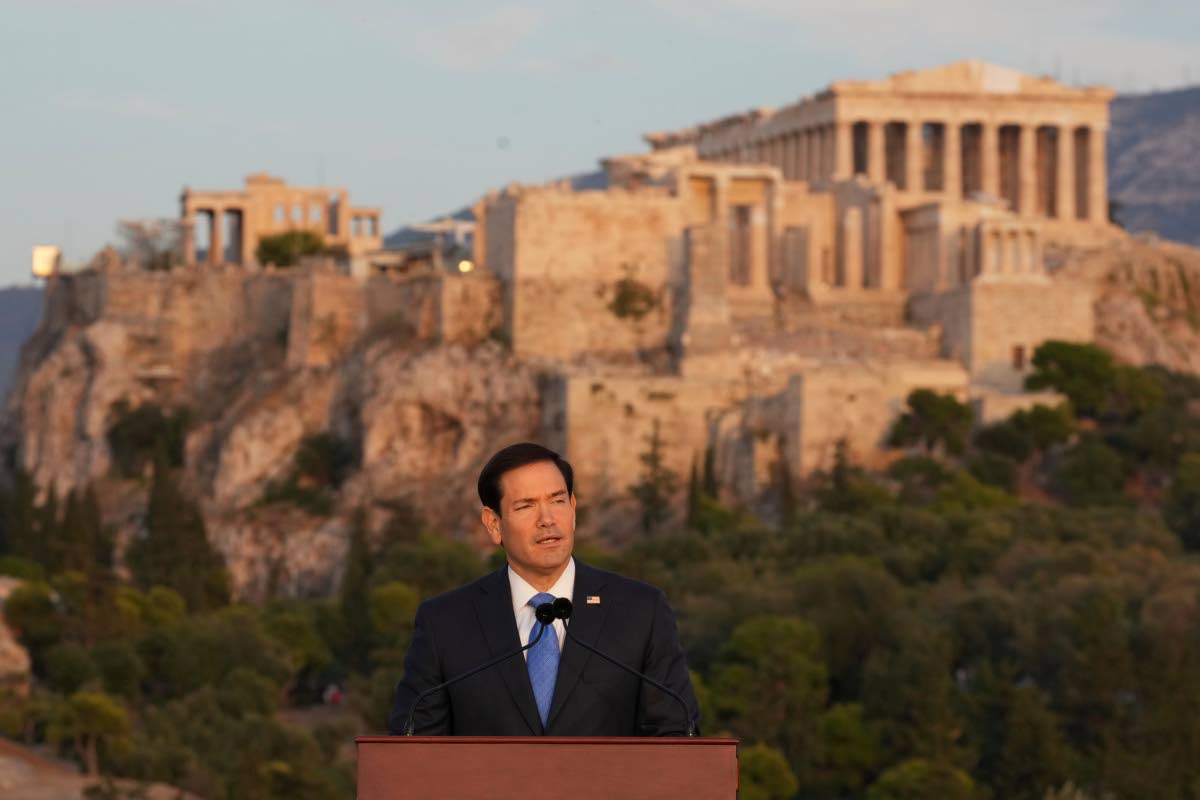 US Secretary of State Marco Rubio speaks at the Pnyx hill, where ancient Athenians held democratic assemblies, with the ancient Parthenon temple atop the Acropolis in the background, in Athens, Wednesday, October 7, 2026. (AP Photo/Mark Schiefelbein, Pool). Photo - Mark Schiefelbein
-
US Secretary of State Marco Rubio speaks at the Pnyx hill, where ancient Athenians held democratic assemblies, with the ancient Parthenon temple atop the Acropolis in the background, in Athens, Wednesday, October 7, 2026. (AP Photo/Mark Schiefelbein, Pool). Photo - Mark Schiefelbein
-
 FILE - This undated photo provided by the Bell County Sheriff's Department shows former Army psychiatrist Maj Nidal Hasan. (Bell County Sheriff's Department via AP, File). Photo - Uncredited
America’s planned livestreaming of the firing-squad execution of Muslim-American former Army officer Nidal Hasan in December seems, in the context of a liberal democracy in the 21st century, a throwback to medieval notions of punishment: the more extreme and theatrical, the better.
In the United States today, the proposed public square-style killing of former Major Hasan, if it proceeds in that fashion, coincides with the personas of those who hold power under President Donald Trump and with how America is attempting to reinterpret its place in Western civilisation.
First, the choice of the method of execution, the firing squad and the livestream, reflects Defence Secretary Pete Hegseth’s macho assertion of America’s supposed no-holds-barred, kick-ass warrior culture. In that regard, the execution of Hasan for his jihad-inspired killing of 13 people at a US Army base in Texas nearly 17 years ago is presented as a visceral striking back at the enemy, writ large.
For Mr Trump, livestreaming an execution sits easily with his low-brow sense of theatre and is in keeping with the kind of reality TV show that provided him with a perch into politics and, ultimately, the presidency. Mr Trump may, in the end, be talked out of final authorisation of the livestream, but his likely instinct would be to consider potential streaming numbers and ratings.
ideological frame
For a broader ideological frame within which to fit the disparate strands of Mr Trump’s MAGA movement, from its ethno-nationalism to its great-power assertion of hegemonic authority, perhaps the best place to look is this week’s speech in Athens by Secretary of State Marco Rubio, in which he attempted to position the United States as the direct heir to the wisdom of the ancient Greeks while making little of the achievements and influence of other cultures.
“What blossomed here in this place was the Western desire to uncover all that ignorance, darkness, and distance had kept hidden from the mind of man,” Mr Rubio said. “The Greeks did not just shape history. The Greeks gave us history itself. Much of what we know about many ancient civilisations comes almost entirely from the records of Greek explorers and historians who didn’t just chronicle the histories of their own people but ventured outward to observe and record the sagas of foreign peoples and cultures across the world.”
He added: “The hunger for new knowledge, that’s what gave birth to Magellan’s first expedition around the world, to Columbus’ discovery of the Americas, and ultimately, to Apollo 11’s journey to the moon. And the qualities that led Alexander to conquer the entire known world reappeared in Caesar then Charlemagne and Cortés.
“And, in America, that same tradition rediscovered itself anew. An open and wild land became the site of a great revival of Western imagination and ambition. The Greek aspiration for new horizons became the American frontier spirit. The civilisation of Athens and Rome transformed an infant seaboard republic into a continental empire.
“The greatest Americans of every generation have carried the unmistakable features of their forefathers – born in Athens, formed by Rome, baptised in Christendom, hardened in the furnace of medieval Europe, endowed with the English genius for liberty, and then carried across the Atlantic to be reborn on the shores of a new world.
“Together, we must now rediscover that spirit. We are at an inflection point - an inflection point not only in the history of my nation but an inflection point in the whole of our civilisation.”
The United States under President Trump, Rubio argued, was already channelling the spirit of the ancient Greeks who, “for all their lofty ideals ... were not naive”.
“They understood that nations have interests,” Mr Rubio said. “They understood that statecraft requires prudence and diplomacy, but they also understood that it requires the ability to wield force when prudence and diplomacy fail. They understood that power requires not only having the means to defend yourself. It requires the credibility that you are willing to use it.
“This is the classical understanding of politics and of statecraft that the Trump Administration hopes to reclaim – reclaim not just for our country but for the whole of our civilisation.”
political statement
Viewed in this larger context, the proposed public execution of Nidal Hasan, a military psychiatrist who became radicalised, is not merely the carrying out of the verdict of a court-martial. Within the spectacle and theatre of the US military’s first execution in 65 years, and America’s first public one in nearly a century, if that claim is accurate, it is a political statement that encapsulates Mr Trump’s bravado, Mr Hegseth’s GI Joe caricaturisation of strength, and what Mr Rubio posited as the United States’ willingness to use its power.
What is forgotten in all this is that America did not accumulate its influence solely through the exertion of military and economic power. Despite its flaws, much of the rest of the world felt that, on balance, the United States was a principled, civilising force for good, not a place where cruelty was exalted, and executions became public theatre.
The United States should remind itself of what nearly happened to Liberté, Égalité, Fraternité when the guillotine became wanton.