Editorial | Regulating AI
Loading article...
-
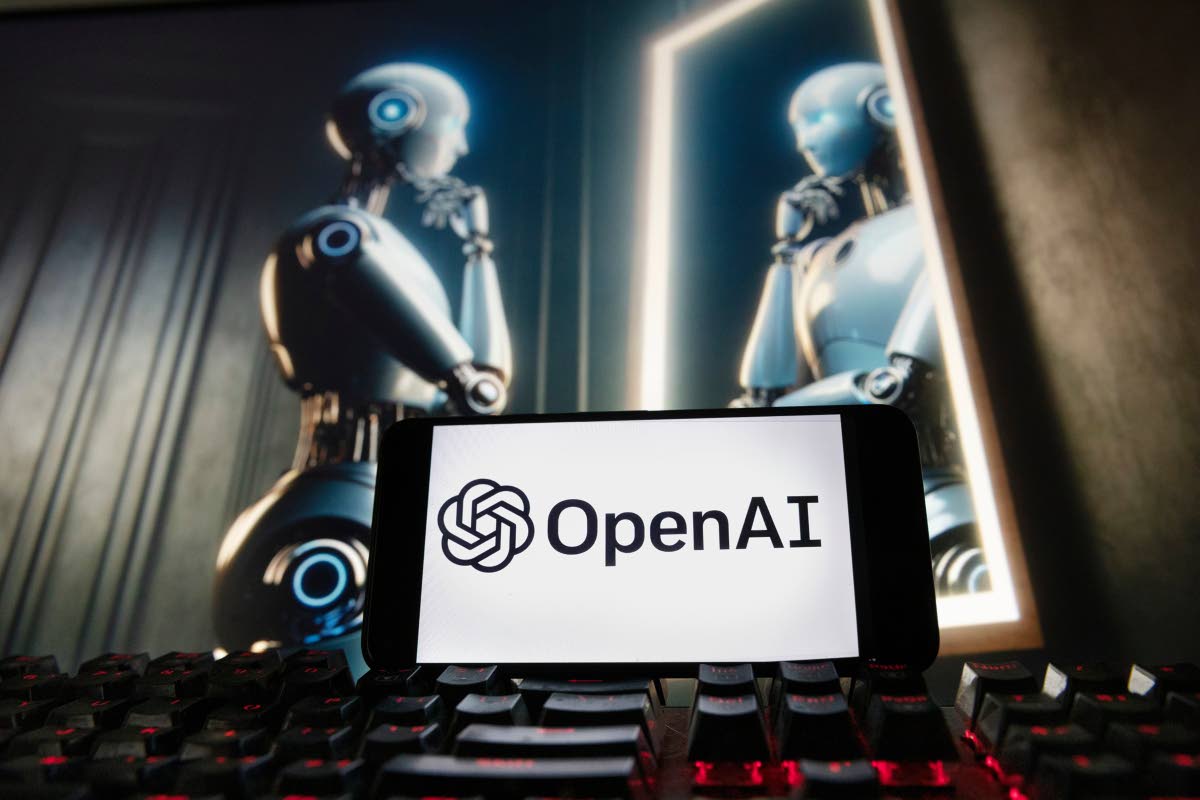 The OpenAI logo is displayed on a cell phone with an image on a computer monitor generated by ChatGPT's Dall-E text-to-image model on December 8, 2023 in Boston. AP
-
 Dario Amodei, CEO and co-founder of Anthropic, at the annual meeting of the World Economic Forum in Davos, Switzerland, on January 23, 2025. AP
The renewed fears of a potentially apocalyptic future caused by artificial intelligence (AI), and calls for a slowdown in the advance of these technologies, again highlight the need for a full and transparent debate in Jamaica on guard rails to prevent these tools from running amok.
But while Jamaica cannot delay its own discussion of a regulatory framework for AI, it would be better, as this newspaper proposed three years ago, if the matter were dealt with on a regional basis as a joint Caribbean Community (CARICOM) project. Fifteen voices in unison, even if they represent small developing countries, are likely to carry greater collective weight and provide a better chance of securing a place at the table than if they spoke individually.
In that regard, the science and technology minister, Andrew Wheatley, must deepen and reframe the mandate of Jamaica’s AI task force to embrace this broader mission. He should also publish an updated report on the task force’s work, including the guidance it provided to the Cabinet since the minister’s May directive on how AI systems should be deployed in government ministries, departments and agencies (MDAs).
Few technologies, and possibly none, have advanced at the frenetic pace of large language model generative AI over a comparable period since OpenAI launched ChatGPT in late 2022. And few have been as potentially transformative to human existence, not least because of AI’s potential to make people’s lives easier and economies more productive and efficient.
But, increasingly, there is the spectre of an apocalypse, or a dystopian world driven by AI, in which machine intelligence surpasses human beings. These fears are not new. Nor are proposals for the technology’s regulation.
CONCERN FROM CREATORS
In early 2023, three founders of OpenAI, Greg Brockman, Ilya Sutskever, and Chief Executive Officer Sam Altman, published an essay in which they expressed concern about the rapid and uncontrolled advance of generative AI and the dangers it presents.
“It is conceivable that within the next 10 years, AI systems will exceed expert skill levels in most domains and carry out as much productive activity as one of today’s largest corporations,” they wrote. “In terms of both potential upsides and downsides, superintelligence will be more powerful than other technologies humanity has had to contend with in the past. We can have a dramatically more prosperous future, but we have to manage risk to get there. Given the possibility of existential risk, we can’t just be reactive.”
Despite those anxieties, OpenAI, like other firms, many of which are now worth hundreds of billions of dollars, has proceeded with the development of its products at breakneck speed, until last week’s warning by former Anthropic and OpenAI researcher Jacob Coxon that things are getting out of hand.
Announcing his resignation from Anthropic, a leading AI company, Mr Coxon said in a social media post: “Neither company is acting responsibly. They are racing straight toward self-improving superintelligence and gambling with our lives.
“The people building AI earnestly believe that it could kill us all by the end of the decade. This is not a marketing stunt. If anything, many executives and senior researchers will couch their phrasing in the press to sound sensible, but I hear those same people express fear privately. No other human activity poses this level of danger.”
He was backed up by other AI researchers, leading to last weekend’s concession by Anthropic CEO Dario Amodei that the risks posed by the technology “require even more prudence, not just investing in risk prevention, but pacing the rate of capability advancement so that risk prevention has time to keep up”.
“We must slow the pace at which we improve the capabilities of AI models,” Mr Amodei wrote. “Progress will still seem fast, and we must make wise use of the time we gain.”
He received support from other AI leaders, including OpenAI’s Mr Altman and Google DeepMind chief Demis Hassabis. On their face, however, Mr Amodei’s proposals are primarily about self-regulation by firms and industry, as well as a suggestion that “the US and other democratic governments attempt to coordinate with authoritarian governments, to the extent this is possible”, on pacing AI development.
There can be no return to the Luddites. But the circumstances and existential dangers demand more than self-regulation.
Despite their command of these technologies, the transformative value of AI and the dangers it pose are not concerns only for the world’s advanced economies. Developing countries, too, have a stake in its evolution and therefore a right to a place at any table where its regulation is considered. Jamaica and CARICOM must be in the vanguard of that cause, insisting on a seat for themselves.
At the same time, this focus on AI, its rapid advance, and recent cases of these intelligences going rogue, again underscores the need for Jamaica to ensure the robustness of its cybersecurity architecture, including the management and ownership of data under state control. Recent cases of lax oversight of data managers operating on behalf of the Government are a grave cause for concern.