Kristen Gyles | Matthew Samuda’s question
Loading article...
-
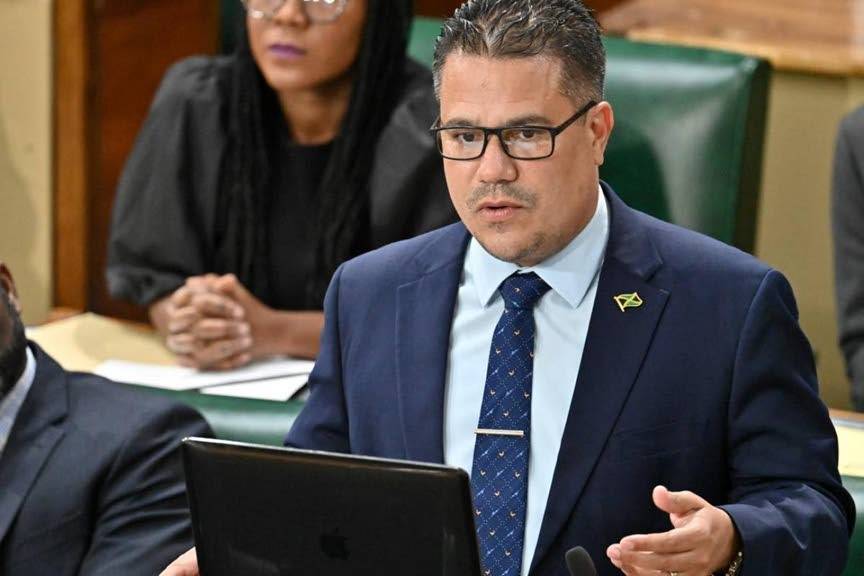 Minister of Water, Environment and Climate Change, Matthew Samuda
-
 Kristen Gyles
Minister Matthew Samuda is right. There is an inherent conflict that arises from parliamentarians having oversight of the operations of the Integrity Commission (IC). The purpose of the Integrity Commission Parliamentary Oversight Committee is to supervise or monitor the operations of the IC and to ensure it is functioning effectively and in keeping with its mandate. How can parliamentarians do this when they themselves are subject to the oversight of the IC?
These current circumstances appear both untidy and improper.
With that said, we need to find an appropriate fix to address this conflict. Since the minister’s comments seem to have gone through several rounds of ‘Chinese telephone’, let us recap what his comments actually were. His suggestion was for research to be conducted (if not already conducted) into “what the appropriate arrangements are for oversight committees of similar commissions within similar jurisprudence”. In other words, how is oversight given to the integrity commissions, anti-corruption commissions and similar bodies in other countries like Jamaica?
Fair question.
He suggested that it was odd for a committee of parliamentarians to be giving oversight to a body that itself gives oversight to parliament. He also mentioned that this situation gives rise to some parliamentarians being reluctant to serve on the oversight committee because of a fear of victimisation, whether real or imagined. Further to those thoughts, he then queried whether parliamentarians who sit on the oversight committee should file with an entity external to the IC, such as the FID.
It was a very sensible and reasoned outline of a problem, followed by a suggestion of how the problem can be solved.
However, the specific suggestion for members of the oversight committee to file their statutory declarations to the FID instead of the IC is problematic for many reasons.
SPECULATION
First, having two or more different groups of declarants filing to two or more different entities opens the door for speculation as to whether both or all groups are being subject to the same level of inspection or scrutiny. Within a context where a very vocal faction of Jamaicans has been painting the IC as being politically biased, shifting to an arrangement that invites the public to compare and contrast the decisions and overall conduct of the IC to that of a sister entity, supposedly tasked with carrying out the same function, may only worsen a negative public perception.
Further, while such a shift is not impossible, it would require sweeping revisions to the current operations of the FID, since its mandate is different from that of the IC.
As we have said, it is generally not practical to have two different bodies reviewing statutory declarations. The problem highlighted by Minister Samuda is valid, but the proposed approach to solving the problem is itself a problem. The approach should not be to have some parliamentarians file to another entity. Instead, we should be questioning why the IC would need to be reporting to Parliament any at all.
The peculiar role of the IC prevents it from functioning like every other government agency. It is not a tool of the government. Instead, it should be independent of government.
From that standpoint, there need not be a parliamentary oversight committee for the IC. There is a joint select committee which is tasked with reviewing the Integrity Commission Act. That is about all the involvement Parliament should have with regards to the work of the IC. And, frankly, such a committee should heavily leverage the expertise of non-parliamentarians. Either way, the point is that while the operations of the IC should certainly be reviewed, it should not be reviewed by a parliamentary group.
REWORKING
It is at points like these that it becomes clear that the structure of Jamaica’s governance system needs reworking. If Jamaica had a head of state that carried out an executive or partially executive role, this issue would have a clear solution. Rather than reporting to Parliament, it would be more appropriate for an entity like the IC to take its guidance from that non-partisan head of state. Of course, Jamaica’s governor general plays mostly a ceremonial role and would not be in a position to receive and review declarations filed by parliamentarians. But, in theory, that is perhaps what would be most appropriate here.
This brings us to an equally important matter raised by Minister Samuda.
He restated a recommendation for employees of the IC to submit their statutory declarations to an external body such as the FID or Auditor General (that is, in the event that the Auditor General is removed from the board of commissioners of the IC). The rationale given was that the staff of the IC should not be filing declarations to … the staff of the IC. It is fairly obvious why.
In some Caribbean jurisdictions, employees of the integrity commission file to the country’s head of state or governor, which is usually a non-political post. But, again, we do not have anything like that. This governance gap lies at the root of many of the ‘conflicts’ we debate over as Jamaicans.
This raises the question, what has become of the constitutional reform process and the proposals for the election of a Jamaican president? Have we fallen off the ‘road to republic’?
Kristen Gyles is a free-thinking public affairs opinionator. Send feedback to kristengyles@gmail.com and columns@gleanerjm.com