Africka Stephens | When will unchecked power in our schools be addressed
Loading article...
-
 Africka Stephens. Photo - Contributed
-
Africka Stephens. Photo - Contributed
-
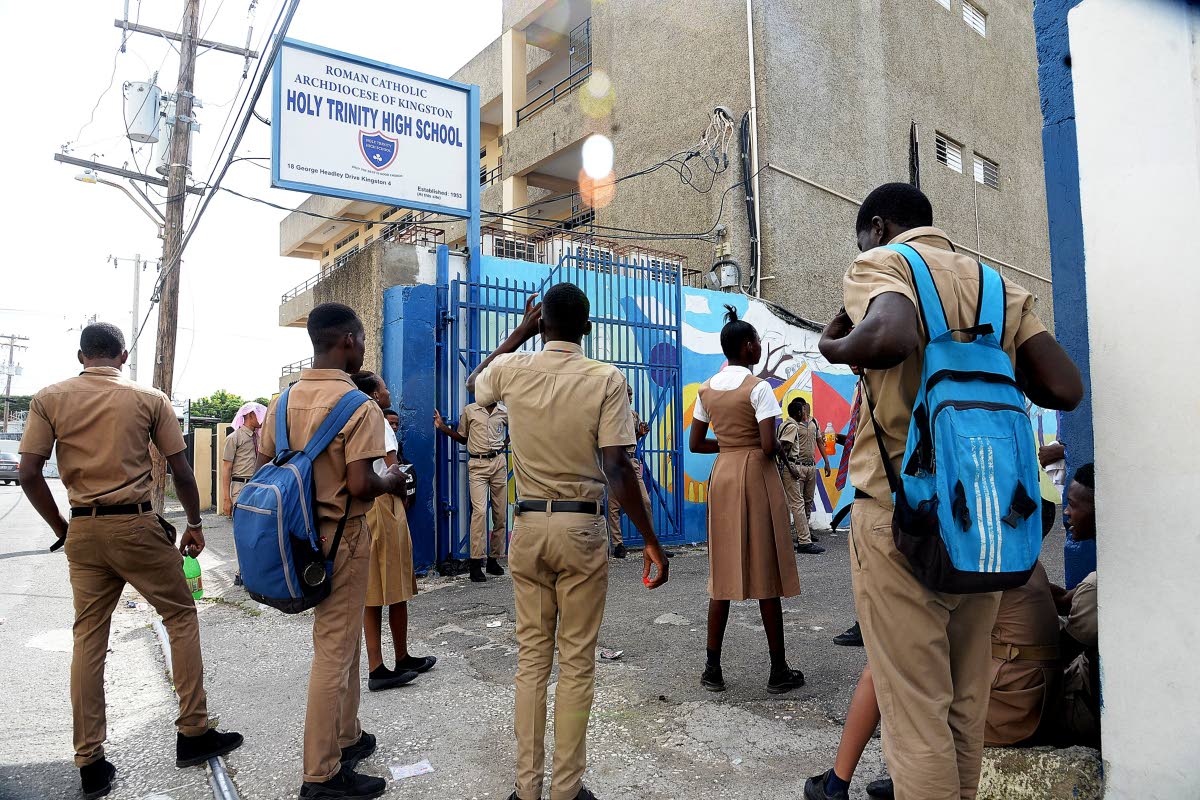 Students from Holy Trinity High School gather near the school gate after they were not permitted on ther school compound for a number of reasons ranging from bleaching and their pants being too tight. Photo - File
Recent reports, from a primary school in Spanish Town, St Catherine, where students’ jackets were reportedly confiscated by school administrators during a cold weather front, have ignited public concern.
Children were allegedly left exposed to cold conditions as a result of rigid enforcement of school rules. While the incident has drawn understandable outrage from parents, it also highlights a deeper and more troubling issue within Jamaica’s education system, the unchecked discretionary power exercised by school administrators, often at the expense of children’s health, dignity, and rights.
Schools are intended to be safe spaces that nurture learning and development. They should never become environments where discomfort or physical distress is used as a disciplinary tool. When rule enforcement disregards a child’s basic needs, the system has lost sight of its purpose.
Jamaica is a tropical country, but this oversimplified narrative ignores our realities. Seasonal cold fronts, early-morning chills, and prolonged periods of rainfall are not uncommon, particularly during the winter months. For young children, especially those attending schools with open classrooms or limited infrastructure, exposure to cold temperature can affect their physical health, emotional well-being, and academic performance.
Confiscating jackets during cold conditions carries real consequences. Children cannot learn effectively when they are uncomfortable or distressed. Any school policy that fails to accommodate basic environmental realities is inherently flawed and requires urgent review.
BECOMES HARMFUL
In recent years, Jamaica has witnessed multiple controversies surrounding the enforcement of grooming and dress code policies, including instances where students were excluded from classrooms or school compounds due to perceived infractions. The dominant response has often been a rigid insistence that “rules are rules”.
Such reasoning is deeply problematic. Rules are not sacred in and of themselves. They exist to serve people, not the other way around. When rules are applied without fairness, proportionality, or compassion, they cease to be instruments of order and become tools of harm. Blind adherence to policy, particularly where children are concerned, reflects a failure of judgment rather than strength of leadership.
At the centre of this issue lies a fundamental principle, children have rights. Every child is entitled to safety, dignity, and humane treatment within educational settings. These are not aspirational ideals. but legal and moral obligations.
Under the Child Care and Protection Act, schools and educators owe a duty of care to students. Additionally, Jamaica is a signatory to the United Nations Convention on the Rights of the Child, which requires that the best interests of the child be a primary consideration in all actions affecting them. Subjecting children to cold exposure as a form of discipline is difficult to reconcile with either standard.
Discipline should educate and correct behaviour, not humiliate, endanger, or exclude. When enforcement methods undermine a child’s physical comfort or emotional security, they cross the line from discipline into punishment.
PROBLEM OF UNCHECKED DISCRETION
Perhaps the most concerning aspect of the jacket confiscation incident is what it reveals about governance in schools. Grooming and dress code policies often grant school administrators wide discretion, giving them the final and unilateral say on what is acceptable. In practice, this discretion is frequently subjective, inconsistently applied, and vulnerable to personal bias.
Such unchecked authority creates fertile ground for arbitrary decision-making. It also disproportionately affects children’s sense of belonging, cultural identity, and self-worth. When children experience discipline as unpredictable or unfair, it erodes trust in institutions meant to protect them.
Flexibility is not a threat to discipline; it is an essential feature of good governance. Policies that cannot adapt to weather conditions, health concerns, or developmental needs are not fit for purpose.
The time has come for a comprehensive revision of Jamaica’s National School Grooming Policy. Any such revision must remove unilateral decision-making power from individual administrators and replace it with clear, consistent, and rights-based standards that apply across the education system.
Beyond policy reform, serious consideration should be given to the enactment of a School Grooming Act. Such legislation should establish enforceable standards, clearly define acceptable disciplinary measures, and ensure accountability where children’s rights are breached. It must protect children’s dignity, safety, freedom of expression, cultural identity, and bodily autonomy, while maintaining reasonable boundaries necessary for order in schools.
Importantly, disciplinary practices must always align with constitutional protections and international human rights obligations.
The welfare of students are often overlooked in the process of enabling order and discipline in schools, However, rules designed to promote order should never come at the expense of a child’s health, comfort, or identity. Any disciplinary approach that humiliates, endangers, or marginalises children is neither educational nor just. It teaches obedience through fear rather than responsibility through understanding.
The Ministry of Education, school boards, and policymakers must urgently review existing grooming and dress code frameworks. Parents, students, educators, and civil society must meaningfully engage in crafting solutions that reflect modern Jamaica and place children at the centre of decision-making.
Until these issues are addressed, incidents like these will continue to recur, each time prompting the same question: when will we put the best interests of the child first?
Africka Stephens is the executive founder of Fi We Children Foundation and attorney-in-waiting. Send feedback to info@fiwechildren.org