Newton D. Duncan | A Brompton childhood: My journey back
Loading article...
-
 Newton D. Duncan, Professor Emeritus of Surgery, University of the West Indies.
-
Newton D. Duncan, Professor Emeritus of Surgery, University of the West Indies.
-
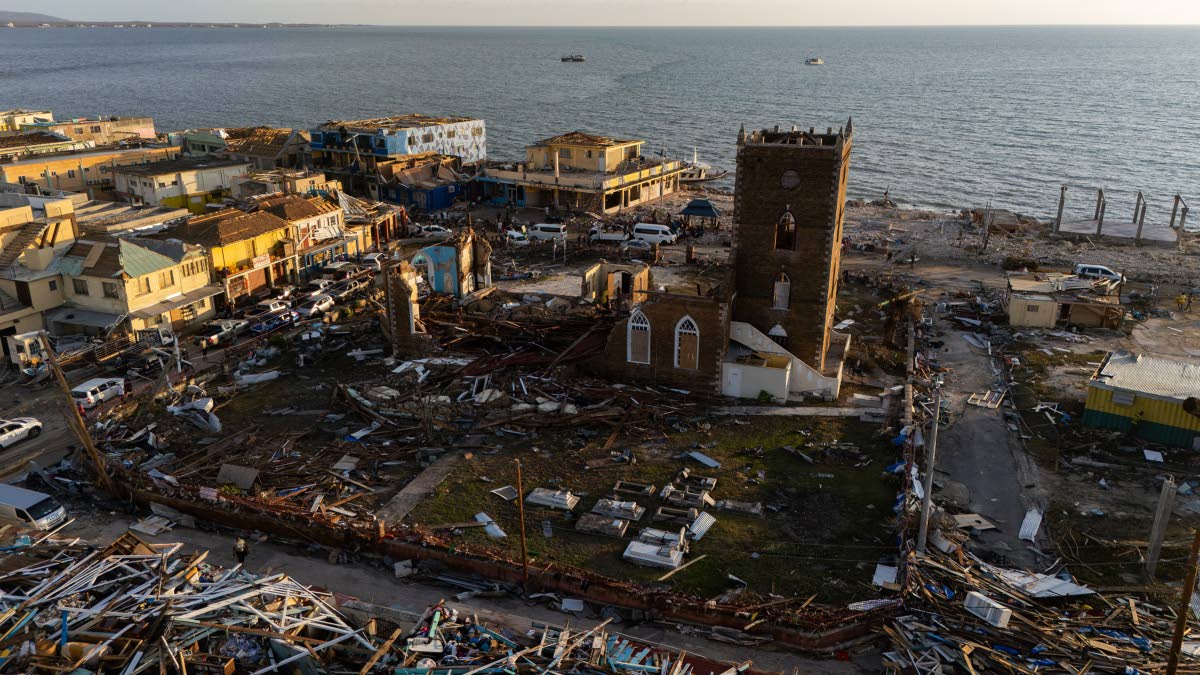 This aerial photo shows St. John Anglican Parish Church in Black River, St Elizabeth, razed by Hurricane Melissa. Photo - Gladstone Taylor
The Daily Gleaner of November 20, 2025, ran an article entitled ‘Earth Today | Running on Empty’, which featured a photograph of the destroyed teacher’s cottage at Brompton Primary School in St Elizabeth.
I lived there in the 1960s with my late aunt, Gertrude Heslop, and her husband Timothy, Head-teacher. The Heslops taught students at Brompton Primary from 1954 to 1973.
I was not born in St Elizabeth but was put there for two years by well-meaning parents, to get a sound primary school foundation. Brompton’s education was more than scholastic, I came to appreciate its expansive green spaces, fruit laden trees and warm welcoming people.
Nostalgic thoughts post Melissa pulled me back there, returning via the parish capital, Black River.
I travelled through Lacovia, remembering as a child, its early morning fog, which would embrace but not impede. Unlike Santa Cruz, traffic flowed freely through Lacovia’s wide thoroughfare. This is an organised district populated by purposeful people, who are now cut down at the knees and humbled. It has now become a region of zinc stripped houses and exposed private domains.
On the road from Lacovia to Middle Quarters, one witnessed a dazzling expanse of snapped tree trunks and severed limbs extending far into the horizon.
This excerpt from Lacovia’s anthem of resilience, ‘Road to Lacovia’, by A. L. Hendricks, told me that this night too would pass:
“This is a long, forbidding road, a narrow,
hard aisle of asphalt …
…To the eye, unyielding
bleak earth has brought her close to famine;
yet through this wild descent of dark
this woman dares to walk, and sing.”
When I arrived at Middle Quarters, crayfish was not on my mind. Gustatory pleasures took second place to memories of 1967, when in the center of this square, at Miss Birdie’s shop and tavern, I watched the transition of Prime Ministerial power from St Elizabeth’s most favoured son, Sir Donald Burns Sangster, to Hugh Shearer, on a grainy Delco powered black and white television.
To my mind, Donald Sangster’s passing was a turning point. Jamaica never again experienced grief to the same extent.
Prior to the arrival of electricity, the road from Middle Quarters to Black River was desolate and dark. With power lines down, this darkness is now revisited on St Elizabeth. I first heard Jose Marti’s poem, ‘Guantanamera’, on this same stretch of road in 1966, while being driven from Miss Birdie’s shop. The Sand Pipers narrated these opening lines to a haunting melody:
“I am a truthful man from the land of the Palm Trees
And before dying I want to share these palms of my soul.”
I passed by Independence Park, once the pride of Black River and known for celebrating St Elizabeth’s many endeavours. It was now a gated enclosure, with piled up refuse sticking out, like the limbs from its amputated populace.
Reaching Black River, its battered bridge stood in the distance like a violated old lady. Sunrise Bakery, my pre-adolescence sweet spot for warm cocoa bread, was now a hollowed-out cavern, providing clear sight of an indifferent sea. Black River’s historic Georgian landmarks were now wreckage, waiting to be carted away, including Invercauld Great House, the meeting place of Georgian majesty and the sea.
The capital’s unbroken silence suggested occupation by something vast and unfathomable. Hurricane Melissa’s deluge of Black River forced me to ponder again the final verse of ‘Guantanamera’, and Jose Marti’s warning to Caribbean people, about the perils of the sea:
“With the poor people of the earth
I want to make my destiny
The little streams of the mountains
Please me more than the sea.”
Five miles from Brompton I drove by The Black River Spa, an anachronism of sorts. Now the town’s oasis for drinking water, bottled by Samaritan’s Purse. I arrived at my destination, Brompton Primary School, recalling that in better days its dashed teacher’s cottage was a stately sight, complete with a weather-beaten red zinc roof, and colonial style ‘wrap around’ verandah. An image of the cottage adorned the cover of my aunt’s funeral programme in 2011, courtesy of her favourite pupil, Donald Keith Duncan.
Close to the downed cottage was a stripped Poinciana tree, flamboyant in its day, with garrulous pods and red plumage. Under this tree, which doubled as shade and makeshift classroom, students learned to recite H D Carberry’s ‘Epitaph’ by rote, naive to its meaning:
“I think they will remember this as the age of lamentations,
…the age of failure of splendid things,
the age of the deformity of splendid things.”
I stopped by the tomb of Reverend Edmund Lyndhurst King, on the grounds of Cambridge United Church. Rev. King, in 1965, had carefully explained to his congregation why the Presbyterian Church was to become The United Church of Jamaica and Grand Cayman.
I still remember the lead off sentence to King’s most impactful sermon, on Sunday, January 24, 1965: “Winston Churchill, the greatest man in the world, is dead”.
This quote from Churchill is as relevant to Brompton’s current peasantry as it was to the Empire’s fighting soldiers:
“Success is not final
Failure is not fatal.
It’s the courage to continue that counts.”
A bumpy course to my destination had culminated in daydreams, peopled by H.D. Carberry, the bard of post-independence Jamaica and Winston Churchill, the British Empire’s foremost war statesman. Daydreaming (every man’s elixir for mental pain) was my “Brompton cocktail” for the day’s pains.
(Wikipedia: “Brompton Cocktail is a euphoric pain relief elixir, reserved for the most severe pains”)
- Newton D. Duncan is Professor Emeritus of Surgery, University of the West Indies. Email feedback to columns@gleanerjm.com